Introduction to LLM

This page provides an easy-to-understand guide on LLMs (Large Language Models) from basics to applications for AI enthusiasts.

Total of 22 articles available. | Currently on page 1 of 1.

Chapter 10 — The LLM Engine Layer

Tenth post of the LLM Primer VI walkthrough. vLLM as the safe default, TensorRT-LLM for peak NVIDIA-only throughput, SGLang for structured and agentic outputs, and TGI/Ollama for the rest.

2026-05-02

Chapter 9 — Speculative Decoding

Ninth post of the LLM Primer VI walkthrough. The draft-verify paradigm — EAGLE, Medusa, MTP, Lookahead, N-gram — and the verification bottleneck that decides real speedup.

2026-05-01

Chapter 6 — Pruning and Knowledge Distillation

Sixth post of the LLM Primer VI walkthrough. Structured vs unstructured pruning, 2:4 sparsity on Hopper, and the distillation lineage from soft probabilities to Patient Knowledge Distillation and MiniLLM.

2026-04-28

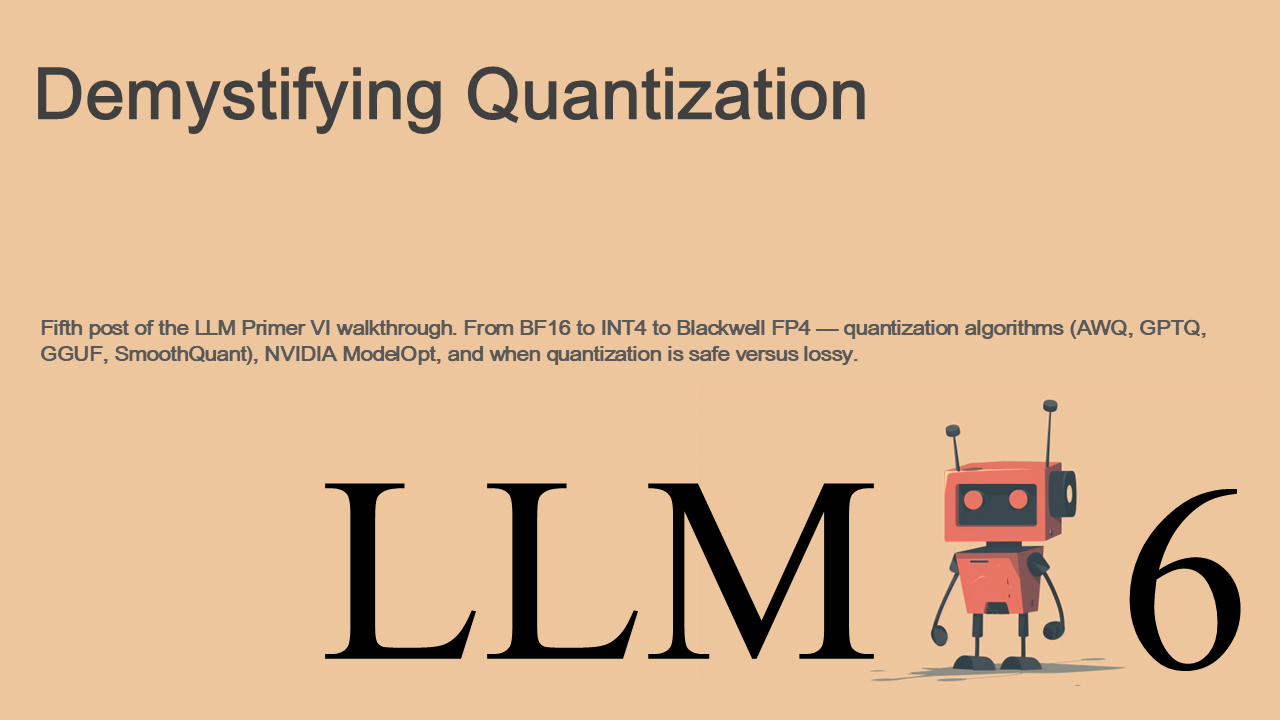
Chapter 5 — Demystifying Quantization

Fifth post of the LLM Primer VI walkthrough. From BF16 to INT4 to Blackwell FP4 — quantization algorithms (AWQ, GPTQ, GGUF, SmoothQuant), NVIDIA ModelOpt, and when quantization is safe versus lossy.

2026-04-27
Chapter 4 — Specialized AI Silicon and ASICs

Fourth post of the LLM Primer VI walkthrough. Groq LPUs, AWS Inferentia2, Google TPUs, and Intel Gaudi — where specialized silicon fits alongside general-purpose GPUs.

2026-04-26

Chapter 3 — Data Center GPUs for Generative AI

Third post of the LLM Primer VI walkthrough. The NVIDIA lineup (H100, H200, B200, L40S) vs AMD MI300X — and why HBM bandwidth matters more than FLOPs for decoding.

2026-04-25

Chapter 1 — The Mechanics of Token Generation

First post of the LLM Primer VI walkthrough. The autoregressive bottleneck, the prefill/decode split, and why a high-end GPU is 99.7% idle while serving a single user.

2026-04-23

LLM Primer VI — Series Introduction & Index

Kicking off the chapter-by-chapter walkthrough of Book VI in the LLM Primer series — Scaling AI Systems. Why inference is the discipline that decides whether an LLM app survives real users, and the schedule for the sixteen posts that follow, April 23 through May 8.

2026-04-22

Chapter 8 — Optimizing Performance, Serving, and Cost

Eighth and final post of the LLM Primer V walkthrough. Semantic caching, dynamic model routing, and what actually happens inside the inference server — plus a look ahead to Volume VI on scaling.

2026-04-21

Chapter 4 — Selecting the Right Vector Database

Fourth post of the LLM Primer III walkthrough. The architectural split between purpose-built vector databases and Postgres-style extensions, the managed leaders (Pinecone, Vertex), the open-source field (Qdrant, Milvus, Weaviate), the embedded options, and the three operational axes — residency, ops, cost — that decide the real choice.

2026-03-21

Chapter 14 — Practical Knowledge for Engineers

Twelfth post — the closing chapter of the LLM Primer II walkthrough. How to keep deepening your understanding after the book ends, the tools and libraries that turn the math into shipping work, and the bridge to the other books in the LLM Primer series.

2026-03-16

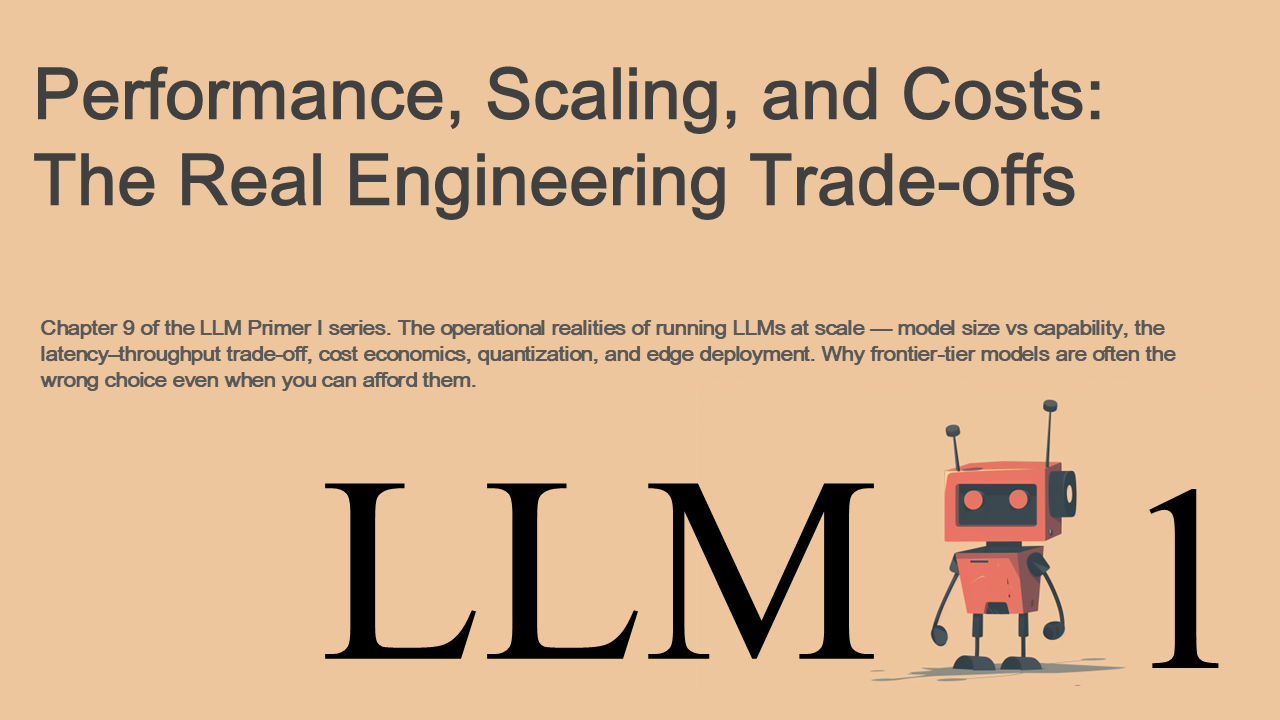
Chapter 9 — Performance, Scaling, and Costs: The Real Engineering Trade-offs

Chapter 9 of the LLM Primer I series. The operational realities of running LLMs at scale — model size vs capability, the latency–throughput trade-off, cost economics, quantization, and edge deployment. Why frontier-tier models are often the wrong choice even when you can afford them.

2026-02-26
Chapter 8 — Using LLMs in Applications: Chatbots, Code, Extraction, and Agents

Chapter 8 of the LLM Primer I series. The application patterns that actually ship in production — chatbots, summarization, code assistants, structured extraction, and the rise of agentic systems where the model drives a tool-use loop. Plus the benchmarks every engineer should recognize by name.

2026-02-25

A Chapter-by-Chapter Walkthrough of LLM Primer I — Series Introduction & Index

Introduction and index for the twelve-part chapter-by-chapter walkthrough of LLM Primer I: How Generative AI Works. One post per day, Feb 18 through March 1, 2026. Read them in order or pick the chapter that matters most to you. All twelve are listed and linked here.

2026-02-17

The LLM Primer Series — A Field Guide to Generative AI, Built One Volume at a Time

The LLM Primer Series — a completed seven-volume field guide to generative AI by Sho Shimoda. From foundations to security. Includes Physical AI as sister volume. All 7 volumes available on Amazon.

2026-02-15

7.3 Integrating Multimodal Models

A preview from Chapter 7.3: Discover how multimodal models fuse text, images, audio, and video to unlock richer AI capabilities beyond text-only LLMs.

2024-10-09

7.2 Resource-Efficient Training

A preview from Chapter 7.2: Learn how techniques like distillation, quantization, distributed training, and data efficiency make LLMs faster, cheaper, and greener.

2024-10-08

7.1 The Evolution of Large-Scale Models

A preview from Chapter 7.1: Explore how LLMs have scaled from billions to trillions of parameters, the gains in performance, and the rising technical and ethical challenges.

2024-10-07

7.0 Future Outlook and Challenges

A preview from Chapter 7: Explore the future of large language models—ethics, efficiency, multimodal AI, and responsible governance beyond scaling.

2024-10-06

5.3 Real-Time Deployment Challenges

A preview from Chapter 5.3: Explore latency, scalability, and optimization techniques for deploying large language models in real-time applications.

2024-10-01

5.2 Compute Resources and Cost

A preview from Chapter 5.2: Learn why LLMs demand massive compute power, what drives cost, and practical strategies to optimize performance and sustainability.

2024-09-30

A Guide to LLMs (Large Language Models): Understanding the Foundations of Generative AI

Learn about large language models (LLMs), including GPT, BERT, and T5, their functionality, training processes, and practical applications in NLP. This guide provides insights for engineers interested in leveraging LLMs in various fields.

2024-09-01