Introduction to LLM
This page provides an easy-to-understand guide on LLMs (Large Language Models) from basics to applications for AI enthusiasts.
Chapter 17 — Future Threats and Emerging Defenses
Seventeenth post of the LLM Primer VII walkthrough — and the series finale. Agent risks and the lethal trifecta, multimodal attack surfaces, deepfakes and C2PA provenance, plus a closing map of the whole LLM Primer arc and the Physical AI sister volume.
2026-05-26
Chapter 16 — Secure Fine-Tuning and Adaptation
Sixteenth post of the LLM Primer VII walkthrough. Why fine-tuning aligned models degrades safety (Qi et al.), poisoned fine-tuning data, and rollback disciplines that keep the safety envelope intact.
2026-05-25
Chapter 15 — Building a Secure AI Organization
Fifteenth post of the LLM Primer VII walkthrough. Security culture for AI teams, red teams and internal audits, vendor risk (SOC 2, ISO 42001), and the emerging AI BOM.
2026-05-24
Chapter 14 — Bias, Fairness, and Responsible AI
Fourteenth post of the LLM Primer VII walkthrough. Sources of bias in LLMs, measurement (BBQ, BOLD, StereoSet, HELM), and the safety-utility trade-off honestly named.
2026-05-23
Chapter 13 — Regulatory Landscape
Thirteenth post of the LLM Primer VII walkthrough. The EU AI Act (Regulation 2024/1689), US EO 14179, Colorado AI Act, NIST AI RMF + GenAI Profile, and ISO/IEC 42001 as the compliance skeleton.
2026-05-22
Chapter 12 — Access Control and Identity
Twelfth post of the LLM Primer VII walkthrough. OAuth 2.0 + PKCE, ABAC vs ReBAC (Zanzibar), multi-tenant isolation, and token-bucket rate limits for LLM APIs.
2026-05-21
Chapter 11 — Observability, Logging, and Incident Response
Eleventh post of the LLM Primer VII walkthrough. Structured LLM logging with PII redaction, OpenTelemetry GenAI conventions, and the NIST SP 800-61 IR cycle adapted for probabilistic systems.
2026-05-20
Chapter 10 — Designing Secure LLM Architectures
Tenth post of the LLM Primer VII walkthrough. Isolation boundaries, policy engines (OPA, Cedar), microVM sandboxes, and the "lethal trifecta" of agent + private data + untrusted content.
2026-05-19
Chapter 9 — Model Integrity and Supply Chain Risks
Ninth post of the LLM Primer VII walkthrough. Open-source model dependency risk, Sleeper Agents (Hubinger et al.), safetensors vs pickle, CVE-2024-3568, and the SLSA / Sigstore artifact-signing discipline.
2026-05-18
Chapter 8 — Adversarial Attacks on Models
Eighth post of the LLM Primer VII walkthrough. Adversarial examples in NLP (HotFlip, TextFooler), model extraction (Tramèr et al., Carlini et al.), and the defensive strategies for API-boundary abuse.
2026-05-17
Chapter 7 — Hallucinations and Reliability
Seventh post of the LLM Primer VII walkthrough. Why hallucinations occur, the confidence-vs-correctness gap, and hybrid verification architectures — anchored by the Moffatt v Air Canada and Mata v Avianca cases.
2026-05-16
Chapter 6 — Retrieval-Augmented Generation Risks
Sixth post of the LLM Primer VII walkthrough. Trust boundaries in RAG, malicious document injection, PoisonedRAG and BadRAG, and monitoring retrieval flows for the attacker's fingerprints.
2026-05-15
Chapter 5 — Input Validation and Output Filtering
Fifth post of the LLM Primer VII walkthrough. Input sanitization, structured guardrails (NeMo, Llama Guard 3, Lakera, Bedrock), and red teaming with Garak, PyRIT, and promptfoo.
2026-05-14
Chapter 4 — Prompt Injection and Jailbreaks
Fourth post of the LLM Primer VII walkthrough. Prompt injection as a structural consequence, the jailbreak taxonomy (DAN, grandma, Zou et al. suffixes, Crescendo, Skeleton Key), and the four-layer mitigation matrix.
2026-05-13
Chapter 3 — Data Security and Privacy
Third post of the LLM Primer VII walkthrough. Training-data risks, memorization and extraction (Carlini et al., Nasr et al.), and the encryption, isolation, and retention disciplines that keep sensitive prompts contained.
2026-05-12
Chapter 2 — Threat Modeling for LLM Systems
Second post of the LLM Primer VII walkthrough. Adapting STRIDE, PASTA, and attack trees to LLM systems — model, prompt, data, and infrastructure as assets, and MITRE ATLAS as the LLM-specific adversary catalog.
2026-05-11
Chapter 1 — Why AI Security Is Different
First post of the LLM Primer VII walkthrough. Why LLM security is structurally different from traditional security — the collapsed code/data boundary, the probabilistic core, and the OWASP LLM Top 10 as a working checklist.
2026-05-10
LLM Primer VII — Series Introduction & Index
Kicking off the chapter-by-chapter walkthrough of Book VII in the LLM Primer series — AI Security. Why in LLM systems code and data are the same string, and the schedule for the seventeen posts that follow, May 10 through May 26. This is the series finale.
2026-05-09
Chapter 16 — Cost-Cutting Strategies in Production
Sixteenth and final post of the LLM Primer VI walkthrough. Intelligent model routing, context compaction, async batch APIs, and semantic caching — plus a look ahead to Volume VII on AI Security.
2026-05-08
Chapter 11 — The Platform and Orchestration Layer
Eleventh post of the LLM Primer VI walkthrough. Engine vs platform — Ray Serve, KServe, BentoML, and NVIDIA Triton — and where each fits in a multi-model pipeline.
2026-05-03
Chapter 8 — Optimizing Performance, Serving, and Cost
Eighth and final post of the LLM Primer V walkthrough. Semantic caching, dynamic model routing, and what actually happens inside the inference server — plus a look ahead to Volume VI on scaling.
2026-04-21
Chapter 7 — LLM Security and Guardrails
Seventh post of the LLM Primer V walkthrough. The OWASP LLM Top 10 as a working checklist, direct-versus-indirect prompt injection, and the four-layer mitigation matrix.
2026-04-20
Chapter 2 — Foundation Models & Prompt Engineering
Second post of the LLM Primer V walkthrough. Model tiering, sampling parameters, defensive prompt patterns, and structured outputs as engineering surfaces — the layer just inside the deterministic wrapper.
2026-04-15
Chapter 12 — Protocol Hardening and Defenses
Thirteenth post of the LLM Primer IV walkthrough. The four defense clusters — cryptographic attestation, OAuth scope discipline with bounded sessions, runtime sandboxing, and human-in-the-loop gates — compose into a posture that does not depend on the model behaving correctly under adversarial conditions.
2026-04-10
Chapter 2 — Unveiling the Model Context Protocol (MCP)
Second post of the LLM Primer IV walkthrough. What MCP actually standardizes, the three-role split of Host, Client, and Server, why dynamic discovery and bidirectional messaging differ from REST in the cases that matter, and the session lifecycle that opens with capability negotiation.
2026-03-31
Chapter 11 — Continuous Updates and Pipeline Optimization
Eleventh and final post of the LLM Primer III walkthrough. CDC and incremental indexing keep the corpus fresh, semantic caching and model tiering keep latency down, and a four-stage feedback loop closes the gap between what production tells the team and what the team actually changes — plus a bridge to Volume IV on Model Context Protocol.
2026-03-28
Chapter 9 — Performance, Scaling, and Costs: The Real Engineering Trade-offs
Chapter 9 of the LLM Primer I series. The operational realities of running LLMs at scale — model size vs capability, the latency–throughput trade-off, cost economics, quantization, and edge deployment. Why frontier-tier models are often the wrong choice even when you can afford them.
2026-02-26
Chapter 8 — Using LLMs in Applications: Chatbots, Code, Extraction, and Agents
Chapter 8 of the LLM Primer I series. The application patterns that actually ship in production — chatbots, summarization, code assistants, structured extraction, and the rise of agentic systems where the model drives a tool-use loop. Plus the benchmarks every engineer should recognize by name.
2026-02-25
Chapter 6 — Fine-Tuning & Adaptation: From Raw Model to Helpful Assistant
Chapter 6 of the LLM Primer I series. The full adaptation stack — from cheap prompt-based steering to parameter-efficient fine-tuning to full alignment with RLHF and its modern successors like DPO. Why post-training is now where closed-model APIs actually differentiate.
2026-02-23
Chapter 5 — Training Large Models: What Actually Goes Into a Frontier Model
Chapter 5 of the LLM Primer I series. How frontier LLMs are actually trained — the data pipeline, the loss function, the months of GPU time, and why "training" is now an industrial-scale engineering problem more than a research problem. Demystifies what those hundred-million-dollar training runs are paying for.
2026-02-22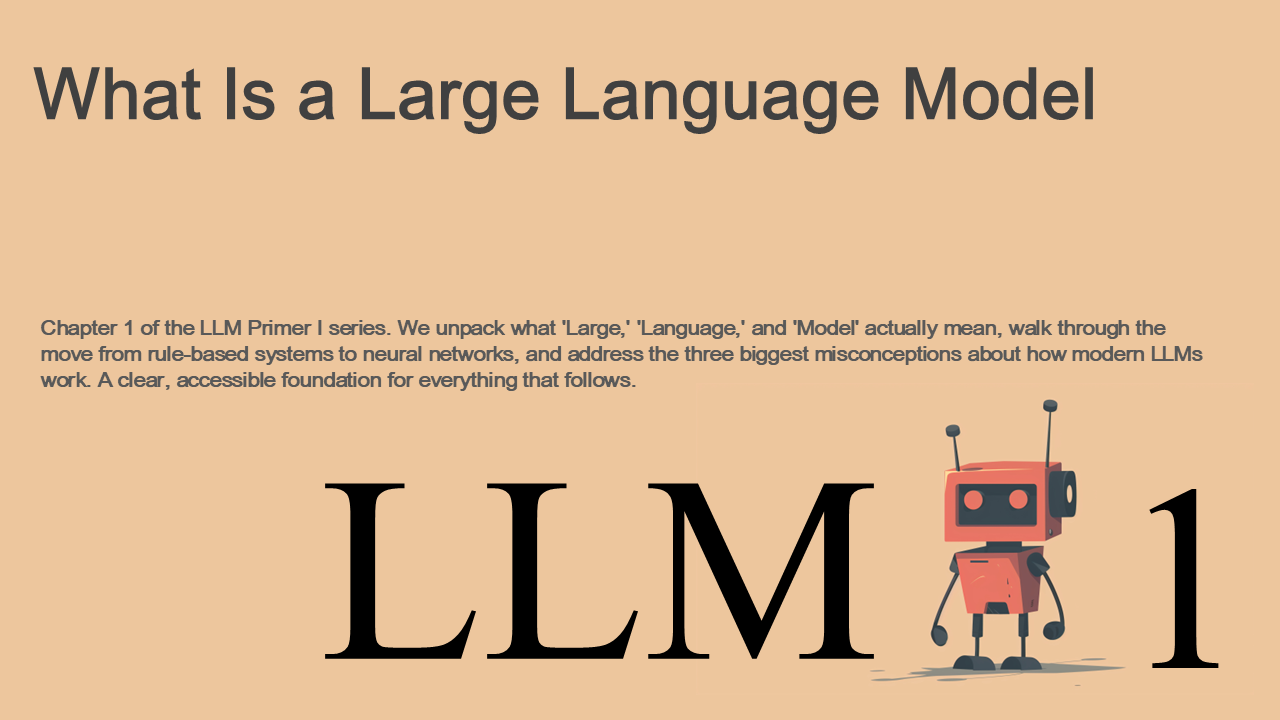
Chapter 1 — What Is a Large Language Model? (Beyond the Headlines)
Chapter 1 of the LLM Primer I series. We unpack what 'Large,' 'Language,' and 'Model' actually mean, walk through the move from rule-based systems to neural networks, and address the three biggest misconceptions about how modern LLMs work. A clear, accessible foundation for everything that follows.
2026-02-18
The LLM Primer Series — A Field Guide to Generative AI, Built One Volume at a Time
The LLM Primer Series — a completed seven-volume field guide to generative AI by Sho Shimoda. From foundations to security. Includes Physical AI as sister volume. All 7 volumes available on Amazon.
2026-02-152.1 What Is a Large Language Model?
A clear and in-depth explanation of what Large Language Models (LLMs) are. Learn how LLMs map token sequences to probability distributions, why next-token prediction unlocks general intelligence, and what makes a model “large.” This section builds the foundation for understanding pretraining, parameters, and scaling laws.
2025-09-08Chapter 2 — LLMs in Context: Concepts and Background
An accessible introduction to Chapter 2 of Understanding LLMs Through Math. Explore what Large Language Models are, why pretraining and parameters matter, how scaling laws shape model performance, and why Transformers revolutionized NLP. This chapter provides essential context before diving deeper into the mechanics of modern LLMs.
2025-09-07
7.3 Integrating Multimodal Models
A preview from Chapter 7.3: Discover how multimodal models fuse text, images, audio, and video to unlock richer AI capabilities beyond text-only LLMs.
2024-10-09
7.1 The Evolution of Large-Scale Models
A preview from Chapter 7.1: Explore how LLMs have scaled from billions to trillions of parameters, the gains in performance, and the rising technical and ethical challenges.
2024-10-07
3.2 LLM Training Steps: Forward Propagation, Backward Propagation, and Optimization
Explore the key steps in training Large Language Models (LLMs), including initialization, forward propagation, loss calculation, backward propagation, and hyperparameter tuning. Learn how these processes help optimize model performance.
2024-09-13
3.1 LLM Training: Dataset Selection and Preprocessing Techniques
Learn about dataset selection and preprocessing techniques for training Large Language Models (LLMs). Explore steps like noise removal, tokenization, normalization, and data balancing for optimized model performance.
2024-09-12
2.1 Transformer Model Explained: Core Architecture of Large Language Models (LLM)
Discover the Transformer model, the backbone of modern Large Language Models (LLM) like GPT and BERT. Learn about its efficient encoder-decoder architecture, self-attention mechanism, and how it revolutionized Natural Language Processing (NLP).
2024-09-07