Introduction to LLM
This page provides an easy-to-understand guide on LLMs (Large Language Models) from basics to applications for AI enthusiasts.
Chapter 17 — Future Threats and Emerging Defenses
Seventeenth post of the LLM Primer VII walkthrough — and the series finale. Agent risks and the lethal trifecta, multimodal attack surfaces, deepfakes and C2PA provenance, plus a closing map of the whole LLM Primer arc and the Physical AI sister volume.
2026-05-26Chapter 16 — Secure Fine-Tuning and Adaptation
Sixteenth post of the LLM Primer VII walkthrough. Why fine-tuning aligned models degrades safety (Qi et al.), poisoned fine-tuning data, and rollback disciplines that keep the safety envelope intact.
2026-05-25Chapter 14 — Bias, Fairness, and Responsible AI
Fourteenth post of the LLM Primer VII walkthrough. Sources of bias in LLMs, measurement (BBQ, BOLD, StereoSet, HELM), and the safety-utility trade-off honestly named.
2026-05-23Chapter 12 — Access Control and Identity
Twelfth post of the LLM Primer VII walkthrough. OAuth 2.0 + PKCE, ABAC vs ReBAC (Zanzibar), multi-tenant isolation, and token-bucket rate limits for LLM APIs.
2026-05-21Chapter 9 — Model Integrity and Supply Chain Risks
Ninth post of the LLM Primer VII walkthrough. Open-source model dependency risk, Sleeper Agents (Hubinger et al.), safetensors vs pickle, CVE-2024-3568, and the SLSA / Sigstore artifact-signing discipline.
2026-05-18Chapter 8 — Adversarial Attacks on Models
Eighth post of the LLM Primer VII walkthrough. Adversarial examples in NLP (HotFlip, TextFooler), model extraction (Tramèr et al., Carlini et al.), and the defensive strategies for API-boundary abuse.
2026-05-17Chapter 7 — Hallucinations and Reliability
Seventh post of the LLM Primer VII walkthrough. Why hallucinations occur, the confidence-vs-correctness gap, and hybrid verification architectures — anchored by the Moffatt v Air Canada and Mata v Avianca cases.
2026-05-16Chapter 6 — Retrieval-Augmented Generation Risks
Sixth post of the LLM Primer VII walkthrough. Trust boundaries in RAG, malicious document injection, PoisonedRAG and BadRAG, and monitoring retrieval flows for the attacker's fingerprints.
2026-05-15Chapter 4 — Prompt Injection and Jailbreaks
Fourth post of the LLM Primer VII walkthrough. Prompt injection as a structural consequence, the jailbreak taxonomy (DAN, grandma, Zou et al. suffixes, Crescendo, Skeleton Key), and the four-layer mitigation matrix.
2026-05-13Chapter 3 — Data Security and Privacy
Third post of the LLM Primer VII walkthrough. Training-data risks, memorization and extraction (Carlini et al., Nasr et al.), and the encryption, isolation, and retention disciplines that keep sensitive prompts contained.
2026-05-12Chapter 2 — Threat Modeling for LLM Systems
Second post of the LLM Primer VII walkthrough. Adapting STRIDE, PASTA, and attack trees to LLM systems — model, prompt, data, and infrastructure as assets, and MITRE ATLAS as the LLM-specific adversary catalog.
2026-05-11LLM Primer VII — Series Introduction & Index
Kicking off the chapter-by-chapter walkthrough of Book VII in the LLM Primer series — AI Security. Why in LLM systems code and data are the same string, and the schedule for the seventeen posts that follow, May 10 through May 26. This is the series finale.
2026-05-09Chapter 4 — Specialized AI Silicon and ASICs
Fourth post of the LLM Primer VI walkthrough. Groq LPUs, AWS Inferentia2, Google TPUs, and Intel Gaudi — where specialized silicon fits alongside general-purpose GPUs.
2026-04-26LLM Primer VI — Series Introduction & Index
Kicking off the chapter-by-chapter walkthrough of Book VI in the LLM Primer series — Scaling AI Systems. Why inference is the discipline that decides whether an LLM app survives real users, and the schedule for the sixteen posts that follow, April 23 through May 8.
2026-04-22Chapter 7 — LLM Security and Guardrails
Seventh post of the LLM Primer V walkthrough. The OWASP LLM Top 10 as a working checklist, direct-versus-indirect prompt injection, and the four-layer mitigation matrix.
2026-04-20Chapter 4 — AI Agents and Tool Calling
Fourth post of the LLM Primer V walkthrough. ReAct loops, tool schemas as contracts, and the three memory layers agents actually need in production.
2026-04-17Chapter 2 — Foundation Models & Prompt Engineering
Second post of the LLM Primer V walkthrough. Model tiering, sampling parameters, defensive prompt patterns, and structured outputs as engineering surfaces — the layer just inside the deterministic wrapper.
2026-04-15Chapter 14 — Benchmarking, Testing, and Performance
Fifteenth and final post of the LLM Primer IV walkthrough. The MCP-Universe Benchmark on real servers, the two systemic failure modes it exposed, the ten-times throughput gap between session-per-request and shared session pools, and the bridge to Volume V.
2026-04-12Chapter 13 — Frameworks and Cloud Integration
Fourteenth post of the LLM Primer IV walkthrough. Strands with Bedrock, the AWS state-layer pattern, the Microsoft Agent Framework, LangChain, Semantic Kernel — and the three production integration shapes teams keep arriving at independently.
2026-04-11Chapter 11 — Continuous Updates and Pipeline Optimization
Eleventh and final post of the LLM Primer III walkthrough. CDC and incremental indexing keep the corpus fresh, semantic caching and model tiering keep latency down, and a four-stage feedback loop closes the gap between what production tells the team and what the team actually changes — plus a bridge to Volume IV on Model Context Protocol.
2026-03-28Chapter 8 — Data Anonymization in the RAG Pipeline
Eighth post of the LLM Primer III walkthrough. Pre-generation versus post-generation anonymisation, the three technique families — masking, synthetic replacement, differential privacy — and the utility-privacy tradeoff that determines whether the system remains useful at all.
2026-03-25Chapter 1 — The Evolution of RAG Architecture
First post of the LLM Primer III walkthrough. The four architectural postures of RAG — Naive, Advanced, Modular, Agentic — read as a story about handing more agency to the LLM one decision at a time, and the honest answer to when fine-tuning is the better tool than retrieval.
2026-03-18Chapter 14 — Practical Knowledge for Engineers
Twelfth post — the closing chapter of the LLM Primer II walkthrough. How to keep deepening your understanding after the book ends, the tools and libraries that turn the math into shipping work, and the bridge to the other books in the LLM Primer series.
2026-03-16Chapter 10 — Post-Training and Alignment Mathematics
Tenth post of the LLM Primer II walkthrough. The mathematics that civilizes a brilliant but feral next-word predictor into a helpful assistant — supervised fine-tuning, reward modeling, RLHF on a KL leash, and the elegant DPO derivation that collapses the whole pipeline into a single supervised loss.
2026-03-12Chapter 8 — How Models Learn
Eighth post of the LLM Primer II walkthrough. Why over-parameterized models generalize at all, the implicit bias of gradient-based optimization, the empirical scaling laws that forecast capability before training, and the open mathematical questions that still surround LLM theory.
2026-03-10Chapter 6 — Transformer Blocks and Representation Power
Sixth post of the LLM Primer II walkthrough. Feed-forward layers, activation functions, why "attention + FFN" is exactly the right pair, and what mathematical guarantees depth and width give you about expressivity.
2026-03-08Chapter 2 — LLMs in Context: Concepts and Background
Second post of the LLM Primer II walkthrough. What an LLM actually is, the three things "pretraining, parameters, scale" really stand for, the unusual nature of language as a data source, and why the transformer rewrote the field in a single year.
2026-03-04Chapter 1 — Mathematical Intuition for Language Models
First post of the LLM Primer II walkthrough. Mathematical notation without intimidation, probability for language generation explained from scratch, and entropy as a way to measure uncertainty — the trio that makes the rest of the book readable.
2026-03-03LLM Primer II — Language Models Through Mathematics: Series Introduction & Index
Kicking off the chapter-by-chapter walkthrough of Book II in the LLM Primer series — Language Models Through Mathematics. How the book is organized, what each chapter delivers, and the schedule for the fourteen posts that follow, March 3 through March 16.
2026-03-02Chapter 12 — Building Your Own LLM System: From Datasets to Production
Chapter 12 of the LLM Primer I series. The final chapter. What it actually takes to build an LLM-powered system end to end — dataset licensing, training pipelines, evaluation frameworks, the integrated application stack, and the case-study patterns that distinguish successful deployments from failed pilots.
2026-03-01Chapter 10 — Safety, Ethics, & Trust: Beyond the Marketing
Chapter 10 of the LLM Primer I series. The honest picture of LLM safety — why hallucinations happen mechanistically, where bias actually lives, how layered guardrails work, and why governance is the institutional layer that technical controls can't replace. For practitioners who need to ship safely.
2026-02-27Chapter 6 — Fine-Tuning & Adaptation: From Raw Model to Helpful Assistant
Chapter 6 of the LLM Primer I series. The full adaptation stack — from cheap prompt-based steering to parameter-efficient fine-tuning to full alignment with RLHF and its modern successors like DPO. Why post-training is now where closed-model APIs actually differentiate.
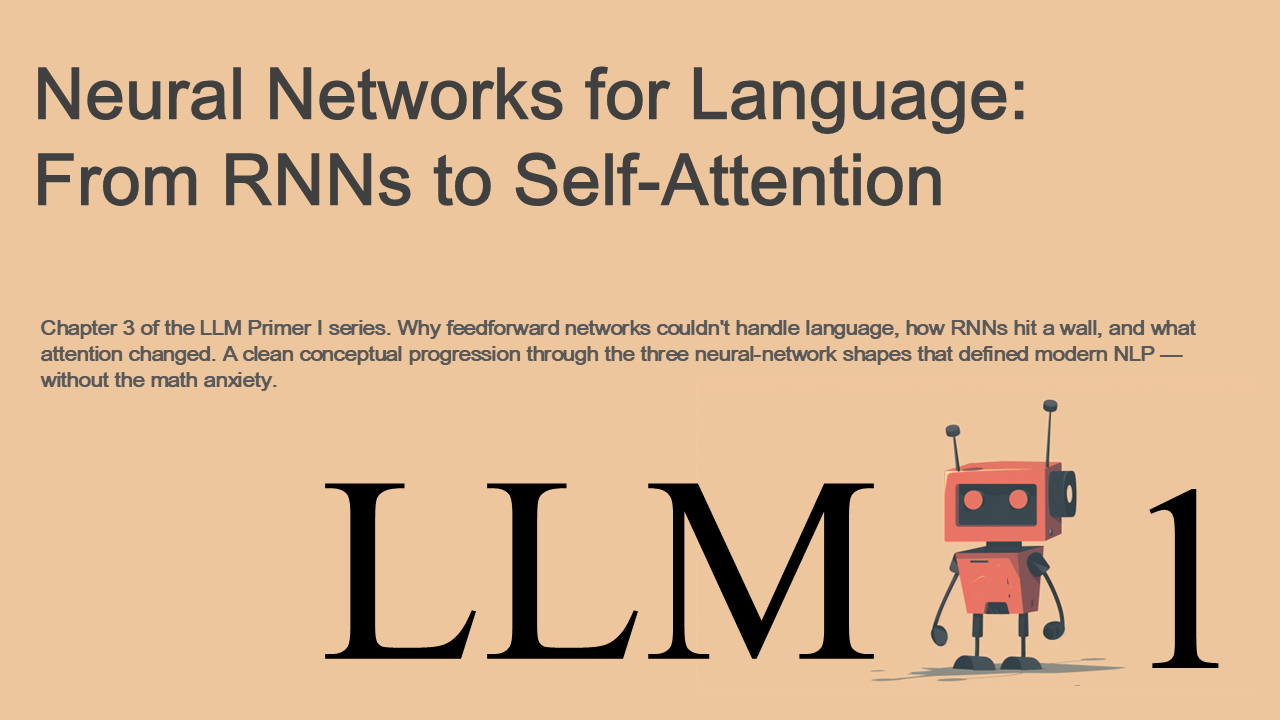
2026-02-23Chapter 3 — Neural Networks for Language: From RNNs to Self-Attention
Chapter 3 of the LLM Primer I series. Why feedforward networks couldn't handle language, how RNNs hit a wall, and what attention changed. A clean conceptual progression through the three neural-network shapes that defined modern NLP — without the math anxiety.
2026-02-20Chapter 2 — Probability, Tokens, and Text: The Game of Next-Word Guessing
Chapter 2 of the LLM Primer I series. How LLMs convert text into tokens, why language modeling is fundamentally a probability problem, and how the old n-gram approach gave way to neural models that can generalize. Includes plain-English explanations of perplexity and why every token boundary matters.
2026-02-19A Chapter-by-Chapter Walkthrough of LLM Primer I — Series Introduction & Index
Introduction and index for the twelve-part chapter-by-chapter walkthrough of LLM Primer I: How Generative AI Works. One post per day, Feb 18 through March 1, 2026. Read them in order or pick the chapter that matters most to you. All twelve are listed and linked here.
2026-02-17The LLM Primer Series — A Field Guide to Generative AI, Built One Volume at a Time
The LLM Primer Series — a completed seven-volume field guide to generative AI by Sho Shimoda. From foundations to security. Includes Physical AI as sister volume. All 7 volumes available on Amazon.
2026-02-15Chapter 2 — LLMs in Context: Concepts and Background
An accessible introduction to Chapter 2 of Understanding LLMs Through Math. Explore what Large Language Models are, why pretraining and parameters matter, how scaling laws shape model performance, and why Transformers revolutionized NLP. This chapter provides essential context before diving deeper into the mechanics of modern LLMs.
2025-09-071.3 Entropy and Information: Quantifying Uncertainty
A clear, intuitive exploration of entropy, information, and uncertainty in Large Language Models. Learn how information theory shapes next-token prediction, why entropy matters for creativity and coherence, and how cross-entropy connects probability to learning. This section concludes Chapter 1 and prepares readers for the conceptual foundations in Chapter 2.
2025-09-06Chapter 1 — Mathematical Intuition for Language Models
An accessible introduction to Chapter 1 of Understanding LLMs Through Math. Learn how mathematical notation, probability, entropy, and information theory form the core intuition behind modern Large Language Models. This chapter builds the foundation for understanding how LLMs generate text and quantify uncertainty.
2025-09-03Understanding LLMs – A Mathematical Approach to the Engine Behind AI
A preview from Chapter 7.4: Discover why large language models inherit bias, the real-world risks, strategies for mitigation, and the growing role of AI governance.
2025-09-017.4 Data Ethics and Bias in Large Language Models
A preview from Chapter 7.4: Discover why large language models inherit bias, the real-world risks, strategies for mitigation, and the growing role of AI governance.
2024-10-097.3 Integrating Multimodal Models
A preview from Chapter 7.3: Discover how multimodal models fuse text, images, audio, and video to unlock richer AI capabilities beyond text-only LLMs.
2024-10-097.2 Resource-Efficient Training
A preview from Chapter 7.2: Learn how techniques like distillation, quantization, distributed training, and data efficiency make LLMs faster, cheaper, and greener.
2024-10-087.1 The Evolution of Large-Scale Models
A preview from Chapter 7.1: Explore how LLMs have scaled from billions to trillions of parameters, the gains in performance, and the rising technical and ethical challenges.
2024-10-077.0 Future Outlook and Challenges
A preview from Chapter 7: Explore the future of large language models—ethics, efficiency, multimodal AI, and responsible governance beyond scaling.
2024-10-066.2 Simple Python Experiments with LLMs
A preview from Chapter 6.2: Learn how to run large language models with Hugging Face, OpenAI, Google Cloud, and Azure using just Python and a few lines of code.
2024-10-056.1 Introducing Open-Source Tools and APIs
A preview from Chapter 6.1: Explore Hugging Face, OpenAI, Google Cloud Vertex AI, and Azure Cognitive Services—leading tools to bring LLMs into your projects.
2024-10-046.0 Hands-On with LLMs
A preview from Chapter 6: Learn how to run large language models yourself with open-source libraries, cloud APIs, and Python—making LLMs accessible to everyone.
2024-10-025.3 Real-Time Deployment Challenges
A preview from Chapter 5.3: Explore latency, scalability, and optimization techniques for deploying large language models in real-time applications.
2024-10-015.2 Compute Resources and Cost
A preview from Chapter 5.2: Learn why LLMs demand massive compute power, what drives cost, and practical strategies to optimize performance and sustainability.
2024-09-30