Introduction to LLM

This page provides an easy-to-understand guide on LLMs (Large Language Models) from basics to applications for AI enthusiasts.

Total of 69 articles available. | Currently on page 1 of 2.

Chapter 17 — Future Threats and Emerging Defenses

Seventeenth post of the LLM Primer VII walkthrough — and the series finale. Agent risks and the lethal trifecta, multimodal attack surfaces, deepfakes and C2PA provenance, plus a closing map of the whole LLM Primer arc and the Physical AI sister volume.

2026-05-26

Chapter 13 — Regulatory Landscape

Thirteenth post of the LLM Primer VII walkthrough. The EU AI Act (Regulation 2024/1689), US EO 14179, Colorado AI Act, NIST AI RMF + GenAI Profile, and ISO/IEC 42001 as the compliance skeleton.

2026-05-22

Chapter 12 — Access Control and Identity

Twelfth post of the LLM Primer VII walkthrough. OAuth 2.0 + PKCE, ABAC vs ReBAC (Zanzibar), multi-tenant isolation, and token-bucket rate limits for LLM APIs.

2026-05-21

Chapter 10 — Designing Secure LLM Architectures

Tenth post of the LLM Primer VII walkthrough. Isolation boundaries, policy engines (OPA, Cedar), microVM sandboxes, and the "lethal trifecta" of agent + private data + untrusted content.

2026-05-19

Chapter 9 — Model Integrity and Supply Chain Risks

Ninth post of the LLM Primer VII walkthrough. Open-source model dependency risk, Sleeper Agents (Hubinger et al.), safetensors vs pickle, CVE-2024-3568, and the SLSA / Sigstore artifact-signing discipline.

2026-05-18

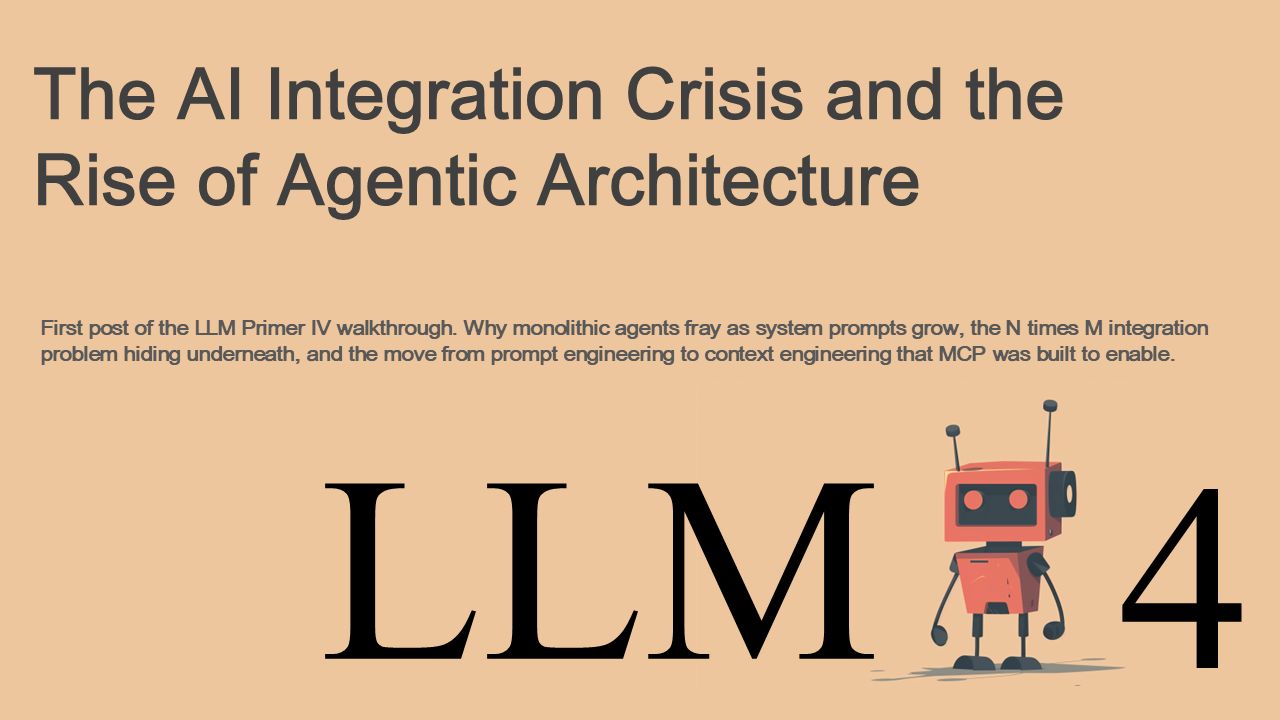
Chapter 8 — Adversarial Attacks on Models

Eighth post of the LLM Primer VII walkthrough. Adversarial examples in NLP (HotFlip, TextFooler), model extraction (Tramèr et al., Carlini et al.), and the defensive strategies for API-boundary abuse.

2026-05-17
Chapter 7 — Hallucinations and Reliability

Seventh post of the LLM Primer VII walkthrough. Why hallucinations occur, the confidence-vs-correctness gap, and hybrid verification architectures — anchored by the Moffatt v Air Canada and Mata v Avianca cases.

2026-05-16

Chapter 5 — Input Validation and Output Filtering

Fifth post of the LLM Primer VII walkthrough. Input sanitization, structured guardrails (NeMo, Llama Guard 3, Lakera, Bedrock), and red teaming with Garak, PyRIT, and promptfoo.

2026-05-14

Chapter 4 — Prompt Injection and Jailbreaks

Fourth post of the LLM Primer VII walkthrough. Prompt injection as a structural consequence, the jailbreak taxonomy (DAN, grandma, Zou et al. suffixes, Crescendo, Skeleton Key), and the four-layer mitigation matrix.

2026-05-13

Chapter 3 — Data Security and Privacy

Third post of the LLM Primer VII walkthrough. Training-data risks, memorization and extraction (Carlini et al., Nasr et al.), and the encryption, isolation, and retention disciplines that keep sensitive prompts contained.

2026-05-12

Chapter 1 — Why AI Security Is Different

First post of the LLM Primer VII walkthrough. Why LLM security is structurally different from traditional security — the collapsed code/data boundary, the probabilistic core, and the OWASP LLM Top 10 as a working checklist.

2026-05-10

LLM Primer VII — Series Introduction & Index

Kicking off the chapter-by-chapter walkthrough of Book VII in the LLM Primer series — AI Security. Why in LLM systems code and data are the same string, and the schedule for the seventeen posts that follow, May 10 through May 26. This is the series finale.

2026-05-09

Chapter 16 — Cost-Cutting Strategies in Production

Sixteenth and final post of the LLM Primer VI walkthrough. Intelligent model routing, context compaction, async batch APIs, and semantic caching — plus a look ahead to Volume VII on AI Security.

2026-05-08

Chapter 15 — Serverless APIs vs Dedicated Infrastructure

Fifteenth post of the LLM Primer VI walkthrough. The breakeven math between serverless APIs and dedicated infrastructure, the hidden platform-engineering overhead each side takes on, and microVM sandboxes for agent code execution.

2026-05-07

Chapter 10 — The LLM Engine Layer

Tenth post of the LLM Primer VI walkthrough. vLLM as the safe default, TensorRT-LLM for peak NVIDIA-only throughput, SGLang for structured and agentic outputs, and TGI/Ollama for the rest.

2026-05-02

Chapter 9 — Speculative Decoding

Ninth post of the LLM Primer VI walkthrough. The draft-verify paradigm — EAGLE, Medusa, MTP, Lookahead, N-gram — and the verification bottleneck that decides real speedup.

2026-05-01

Chapter 8 — Next-Generation KV Cache Management

Eighth post of the LLM Primer VI walkthrough. PagedAttention, KV eviction algorithms (H2O, InfiniGen), and prefix caching for multi-turn conversations and multi-agent RAG.

2026-04-30

Chapter 6 — Pruning and Knowledge Distillation

Sixth post of the LLM Primer VI walkthrough. Structured vs unstructured pruning, 2:4 sparsity on Hopper, and the distillation lineage from soft probabilities to Patient Knowledge Distillation and MiniLLM.

2026-04-28

Chapter 4 — Specialized AI Silicon and ASICs

Fourth post of the LLM Primer VI walkthrough. Groq LPUs, AWS Inferentia2, Google TPUs, and Intel Gaudi — where specialized silicon fits alongside general-purpose GPUs.

2026-04-26

Chapter 1 — The Discipline of AI Engineering

First post of the LLM Primer V walkthrough. Why the demo works and production doesn't — the deterministic wrapper around the probabilistic core, and the five pillars (reliability, quality, performance, cost, evolution) that keep the wrapper honest.

2026-04-14

LLM Primer V — Series Introduction & Index

Kicking off the chapter-by-chapter walkthrough of Book V in the LLM Primer series — Building Real-World LLM Applications. Why AI engineering is a discipline of its own, who this book is for, and the schedule for the eight posts that follow, April 14 through April 21.

2026-04-13

Chapter 14 — Benchmarking, Testing, and Performance

Fifteenth and final post of the LLM Primer IV walkthrough. The MCP-Universe Benchmark on real servers, the two systemic failure modes it exposed, the ten-times throughput gap between session-per-request and shared session pools, and the bridge to Volume V.

2026-04-12

Chapter 10 — Long-Horizon Task Memory

Tenth post of the LLM Primer IV walkthrough. Short-term memory through windows and ReAct scratchpads, long-term memory through episodic vectors and semantic stores, and the compaction techniques that keep an agent productive over hours and days.

2026-04-08

Chapter 9 — Managing the Attention Budget

Ninth post of the LLM Primer IV walkthrough. Context rot, the lost-in-the-middle cliff, tool-loadout rot, and the three architectural answers — MCP, RAG, fine-tuning — to the question of where a model's missing knowledge actually belongs.

2026-04-07

Chapter 8 — Architectural Deployment Layouts

Eighth post of the LLM Primer IV walkthrough. The three deployment layouts that have emerged in the MCP ecosystem — reusable agent, strict purity, hybrid — and the four binding constraints that determine which one fits which project.

2026-04-06

Chapter 1 — The AI Integration Crisis and the Rise of Agentic Architecture

First post of the LLM Primer IV walkthrough. Why monolithic agents fray as system prompts grow, the N times M integration problem hiding underneath, and the move from prompt engineering to context engineering that MCP was built to enable.

2026-03-30
LLM Primer IV — Series Introduction & Index

Kicking off the chapter-by-chapter walkthrough of Book IV in the LLM Primer series — Designing AI Cognition with MCP. Why agents need a protocol layer to scale past demoware, who this book is for, and the schedule for the fourteen posts that follow, March 30 through April 12.

2026-03-29

Chapter 11 — Continuous Updates and Pipeline Optimization

Eleventh and final post of the LLM Primer III walkthrough. CDC and incremental indexing keep the corpus fresh, semantic caching and model tiering keep latency down, and a four-stage feedback loop closes the gap between what production tells the team and what the team actually changes — plus a bridge to Volume IV on Model Context Protocol.

2026-03-28

Chapter 8 — Data Anonymization in the RAG Pipeline

Eighth post of the LLM Primer III walkthrough. Pre-generation versus post-generation anonymisation, the three technique families — masking, synthetic replacement, differential privacy — and the utility-privacy tradeoff that determines whether the system remains useful at all.

2026-03-25

Chapter 7 — Implementing Access Control

Seventh post of the LLM Primer III walkthrough. Document-level ACLs as the foundation, RBAC with Microsoft Purview sensitivity labels, ReBAC with Zanzibar and SpiceDB, and the pre-filter versus post-filter discipline that runs underneath all of them.

2026-03-24

Chapter 5 — Architecting the Retrieval Pipeline

Fifth post of the LLM Primer III walkthrough. Why a single vector search is not a pipeline — hybrid retrieval, reciprocal rank fusion, cross-encoder reranking, and query-side rewriting and HyDE — assembled into the production architecture that mature RAG systems converge on.

2026-03-22
Chapter 4 — Selecting the Right Vector Database

Fourth post of the LLM Primer III walkthrough. The architectural split between purpose-built vector databases and Postgres-style extensions, the managed leaders (Pinecone, Vertex), the open-source field (Qdrant, Milvus, Weaviate), the embedded options, and the three operational axes — residency, ops, cost — that decide the real choice.

2026-03-21

Chapter 1 — The Evolution of RAG Architecture

First post of the LLM Primer III walkthrough. The four architectural postures of RAG — Naive, Advanced, Modular, Agentic — read as a story about handing more agency to the LLM one decision at a time, and the honest answer to when fine-tuning is the better tool than retrieval.

2026-03-18
LLM Primer III — Series Introduction & Index

Kicking off the chapter-by-chapter walkthrough of Book III in the LLM Primer series — Enhancing Enterprise AI with RAG. Why retrieval-augmented generation looks simple from the outside and is a stack of disciplines underneath, who this book is for, and the schedule for the eleven posts that follow, March 18 through March 28.

2026-03-17

Chapter 14 — Practical Knowledge for Engineers

Twelfth post — the closing chapter of the LLM Primer II walkthrough. How to keep deepening your understanding after the book ends, the tools and libraries that turn the math into shipping work, and the bridge to the other books in the LLM Primer series.

2026-03-16

Chapter 12 — Real-World Applications of LLMs

Twelfth post of the LLM Primer II walkthrough. Text generation, summarization, QA, translation, reasoning — and the constrained decoding, agent loops, and multimodal generalization that turn one next-token machine into a dozen kinds of product.

2026-03-14

Chapter 9 — Training at Scale

Ninth post of the LLM Primer II walkthrough. How data preprocessing quietly shapes everything that follows, the mathematics of mini-batch learning and parallelism, and the surprisingly subtle question of how to keep a training run numerically stable across thousands of GPUs.

2026-03-11

Chapter 6 — Transformer Blocks and Representation Power

Sixth post of the LLM Primer II walkthrough. Feed-forward layers, activation functions, why "attention + FFN" is exactly the right pair, and what mathematical guarantees depth and width give you about expressivity.

2026-03-08

Chapter 5 — Position, Order, and Sequence Structure

Fifth post of the LLM Primer II walkthrough. How transformers acquire a sense of order — from the original sinusoidal encoding to relative position to RoPE — and a striking final view that ties the whole apparatus to Fourier analysis.

2026-03-07

Chapter 2 — LLMs in Context: Concepts and Background

Second post of the LLM Primer II walkthrough. What an LLM actually is, the three things "pretraining, parameters, scale" really stand for, the unusual nature of language as a data source, and why the transformer rewrote the field in a single year.

2026-03-04

Chapter 1 — Mathematical Intuition for Language Models

First post of the LLM Primer II walkthrough. Mathematical notation without intimidation, probability for language generation explained from scratch, and entropy as a way to measure uncertainty — the trio that makes the rest of the book readable.

2026-03-03

Chapter 12 — Building Your Own LLM System: From Datasets to Production

Chapter 12 of the LLM Primer I series. The final chapter. What it actually takes to build an LLM-powered system end to end — dataset licensing, training pipelines, evaluation frameworks, the integrated application stack, and the case-study patterns that distinguish successful deployments from failed pilots.

2026-03-01

Chapter 11 — Cutting-Edge Research: MoE, Reasoning Models, and the New Scaling Axis

Chapter 11 of the LLM Primer I series. The research frontiers that are now production reality — mixture-of-experts, retrieval-augmented memory, native multimodal tokenization, continual learning, and the inference-time scaling paradigm that produced today's reasoning models. The 2026 edition's biggest content addition.

2026-02-28

Chapter 5 — Training Large Models: What Actually Goes Into a Frontier Model

Chapter 5 of the LLM Primer I series. How frontier LLMs are actually trained — the data pipeline, the loss function, the months of GPU time, and why "training" is now an industrial-scale engineering problem more than a research problem. Demystifies what those hundred-million-dollar training runs are paying for.

2026-02-22

Chapter 4 — The Transformer Architecture: Inside the Engine of Modern AI

Chapter 4 of the LLM Primer I series. A tour of the Transformer block — how self-attention, positional encoding, and stacked layers combine to produce the architecture every modern LLM is built on. Includes a clear explanation of why scaling Transformers works, and what it costs.

2026-02-21
Chapter 3 — Neural Networks for Language: From RNNs to Self-Attention

Chapter 3 of the LLM Primer I series. Why feedforward networks couldn't handle language, how RNNs hit a wall, and what attention changed. A clean conceptual progression through the three neural-network shapes that defined modern NLP — without the math anxiety.

2026-02-20

A Chapter-by-Chapter Walkthrough of LLM Primer I — Series Introduction & Index

Introduction and index for the twelve-part chapter-by-chapter walkthrough of LLM Primer I: How Generative AI Works. One post per day, Feb 18 through March 1, 2026. Read them in order or pick the chapter that matters most to you. All twelve are listed and linked here.

2026-02-17

The LLM Primer Series — A Field Guide to Generative AI, Built One Volume at a Time

The LLM Primer Series — a completed seven-volume field guide to generative AI by Sho Shimoda. From foundations to security. Includes Physical AI as sister volume. All 7 volumes available on Amazon.

2026-02-15

2.1 What Is a Large Language Model?

A clear and in-depth explanation of what Large Language Models (LLMs) are. Learn how LLMs map token sequences to probability distributions, why next-token prediction unlocks general intelligence, and what makes a model “large.” This section builds the foundation for understanding pretraining, parameters, and scaling laws.

2025-09-08

Chapter 2 — LLMs in Context: Concepts and Background

An accessible introduction to Chapter 2 of Understanding LLMs Through Math. Explore what Large Language Models are, why pretraining and parameters matter, how scaling laws shape model performance, and why Transformers revolutionized NLP. This chapter provides essential context before diving deeper into the mechanics of modern LLMs.

2025-09-07