Introduction to LLM

This page provides an easy-to-understand guide on LLMs (Large Language Models) from basics to applications for AI enthusiasts.

Total of 38 articles available. | Currently on page 1 of 1.

Chapter 17 — Future Threats and Emerging Defenses

Seventeenth post of the LLM Primer VII walkthrough — and the series finale. Agent risks and the lethal trifecta, multimodal attack surfaces, deepfakes and C2PA provenance, plus a closing map of the whole LLM Primer arc and the Physical AI sister volume.

2026-05-26
Chapter 16 — Secure Fine-Tuning and Adaptation

Sixteenth post of the LLM Primer VII walkthrough. Why fine-tuning aligned models degrades safety (Qi et al.), poisoned fine-tuning data, and rollback disciplines that keep the safety envelope intact.

2026-05-25

Chapter 15 — Building a Secure AI Organization

Fifteenth post of the LLM Primer VII walkthrough. Security culture for AI teams, red teams and internal audits, vendor risk (SOC 2, ISO 42001), and the emerging AI BOM.

2026-05-24

Chapter 14 — Bias, Fairness, and Responsible AI

Fourteenth post of the LLM Primer VII walkthrough. Sources of bias in LLMs, measurement (BBQ, BOLD, StereoSet, HELM), and the safety-utility trade-off honestly named.

2026-05-23

Chapter 9 — Model Integrity and Supply Chain Risks

Ninth post of the LLM Primer VII walkthrough. Open-source model dependency risk, Sleeper Agents (Hubinger et al.), safetensors vs pickle, CVE-2024-3568, and the SLSA / Sigstore artifact-signing discipline.

2026-05-18

Chapter 8 — Adversarial Attacks on Models

Eighth post of the LLM Primer VII walkthrough. Adversarial examples in NLP (HotFlip, TextFooler), model extraction (Tramèr et al., Carlini et al.), and the defensive strategies for API-boundary abuse.

2026-05-17
Chapter 7 — Hallucinations and Reliability

Seventh post of the LLM Primer VII walkthrough. Why hallucinations occur, the confidence-vs-correctness gap, and hybrid verification architectures — anchored by the Moffatt v Air Canada and Mata v Avianca cases.

2026-05-16

Chapter 6 — Retrieval-Augmented Generation Risks

Sixth post of the LLM Primer VII walkthrough. Trust boundaries in RAG, malicious document injection, PoisonedRAG and BadRAG, and monitoring retrieval flows for the attacker's fingerprints.

2026-05-15

Chapter 5 — Input Validation and Output Filtering

Fifth post of the LLM Primer VII walkthrough. Input sanitization, structured guardrails (NeMo, Llama Guard 3, Lakera, Bedrock), and red teaming with Garak, PyRIT, and promptfoo.

2026-05-14

Chapter 4 — Prompt Injection and Jailbreaks

Fourth post of the LLM Primer VII walkthrough. Prompt injection as a structural consequence, the jailbreak taxonomy (DAN, grandma, Zou et al. suffixes, Crescendo, Skeleton Key), and the four-layer mitigation matrix.

2026-05-13

Chapter 3 — Data Security and Privacy

Third post of the LLM Primer VII walkthrough. Training-data risks, memorization and extraction (Carlini et al., Nasr et al.), and the encryption, isolation, and retention disciplines that keep sensitive prompts contained.

2026-05-12

Chapter 2 — Threat Modeling for LLM Systems

Second post of the LLM Primer VII walkthrough. Adapting STRIDE, PASTA, and attack trees to LLM systems — model, prompt, data, and infrastructure as assets, and MITRE ATLAS as the LLM-specific adversary catalog.

2026-05-11

LLM Primer VII — Series Introduction & Index

Kicking off the chapter-by-chapter walkthrough of Book VII in the LLM Primer series — AI Security. Why in LLM systems code and data are the same string, and the schedule for the seventeen posts that follow, May 10 through May 26. This is the series finale.

2026-05-09

Chapter 16 — Cost-Cutting Strategies in Production

Sixteenth and final post of the LLM Primer VI walkthrough. Intelligent model routing, context compaction, async batch APIs, and semantic caching — plus a look ahead to Volume VII on AI Security.

2026-05-08

Chapter 6 — Pruning and Knowledge Distillation

Sixth post of the LLM Primer VI walkthrough. Structured vs unstructured pruning, 2:4 sparsity on Hopper, and the distillation lineage from soft probabilities to Patient Knowledge Distillation and MiniLLM.

2026-04-28

Chapter 5 — Demystifying Quantization

Fifth post of the LLM Primer VI walkthrough. From BF16 to INT4 to Blackwell FP4 — quantization algorithms (AWQ, GPTQ, GGUF, SmoothQuant), NVIDIA ModelOpt, and when quantization is safe versus lossy.

2026-04-27

Chapter 3 — Retrieval-Augmented Generation

Third post of the LLM Primer V walkthrough. The RAG pipeline end to end — chunking, hybrid retrieval, query transformation, multimodal, and text-to-SQL — and where RAG fits versus fine-tuning and long context.

2026-04-16
Chapter 2 — Foundation Models & Prompt Engineering

Second post of the LLM Primer V walkthrough. Model tiering, sampling parameters, defensive prompt patterns, and structured outputs as engineering surfaces — the layer just inside the deterministic wrapper.

2026-04-15

LLM Primer V — Series Introduction & Index

Kicking off the chapter-by-chapter walkthrough of Book V in the LLM Primer series — Building Real-World LLM Applications. Why AI engineering is a discipline of its own, who this book is for, and the schedule for the eight posts that follow, April 14 through April 21.

2026-04-13

Chapter 11 — Attack Surfaces and Protocol Vulnerabilities

Eleventh post of the LLM Primer IV walkthrough. The classical attacks adapted to MCP — Confused Deputy, Token Passthrough, Session Hijacking — the protocol-level flaws around capability escalation and unauthenticated sampling, and the implicit trust propagation that makes context poisoning a structural problem rather than a hygiene one.

2026-04-09
Chapter 6 — RAG Threat Models and Vulnerabilities

Sixth post of the LLM Primer III walkthrough. The expanded attack surface of retrieval — corpus poisoning, adversarial chunks, indirect prompt injection, embedding inversion, and the confused-deputy problem in agentic RAG. Concrete attacks, each demonstrated, each reproducible.

2026-03-23
Chapter 3 — Advanced Chunking Frameworks

Third post of the LLM Primer III walkthrough. The chunking spectrum from fixed-size to structure-aware, the overlap myth, the context cliff that destroys retrieval quietly, and the contextual-retrieval and late-chunking techniques that have reshaped the frontier.

2026-03-20

Chapter 2 — Intelligent Document Parsing

Second post of the LLM Primer III walkthrough. Why a PDF is not a text file, what layout-aware parsers actually preserve, the current tool landscape (LlamaParse, Docling, Unstructured, Marker-PDF, Firecrawl, DeepSeek-OCR), and the multimodal track that retrieves over page images directly.

2026-03-19
Chapter 1 — The Evolution of RAG Architecture

First post of the LLM Primer III walkthrough. The four architectural postures of RAG — Naive, Advanced, Modular, Agentic — read as a story about handing more agency to the LLM one decision at a time, and the honest answer to when fine-tuning is the better tool than retrieval.

2026-03-18

LLM Primer III — Series Introduction & Index

Kicking off the chapter-by-chapter walkthrough of Book III in the LLM Primer series — Enhancing Enterprise AI with RAG. Why retrieval-augmented generation looks simple from the outside and is a stack of disciplines underneath, who this book is for, and the schedule for the eleven posts that follow, March 18 through March 28.

2026-03-17

Chapter 12 — Real-World Applications of LLMs

Twelfth post of the LLM Primer II walkthrough. Text generation, summarization, QA, translation, reasoning — and the constrained decoding, agent loops, and multimodal generalization that turn one next-token machine into a dozen kinds of product.

2026-03-14
Chapter 11 — Cutting-Edge Research: MoE, Reasoning Models, and the New Scaling Axis

Chapter 11 of the LLM Primer I series. The research frontiers that are now production reality — mixture-of-experts, retrieval-augmented memory, native multimodal tokenization, continual learning, and the inference-time scaling paradigm that produced today's reasoning models. The 2026 edition's biggest content addition.

2026-02-28
Chapter 10 — Safety, Ethics, & Trust: Beyond the Marketing

Chapter 10 of the LLM Primer I series. The honest picture of LLM safety — why hallucinations happen mechanistically, where bias actually lives, how layered guardrails work, and why governance is the institutional layer that technical controls can't replace. For practitioners who need to ship safely.

2026-02-27

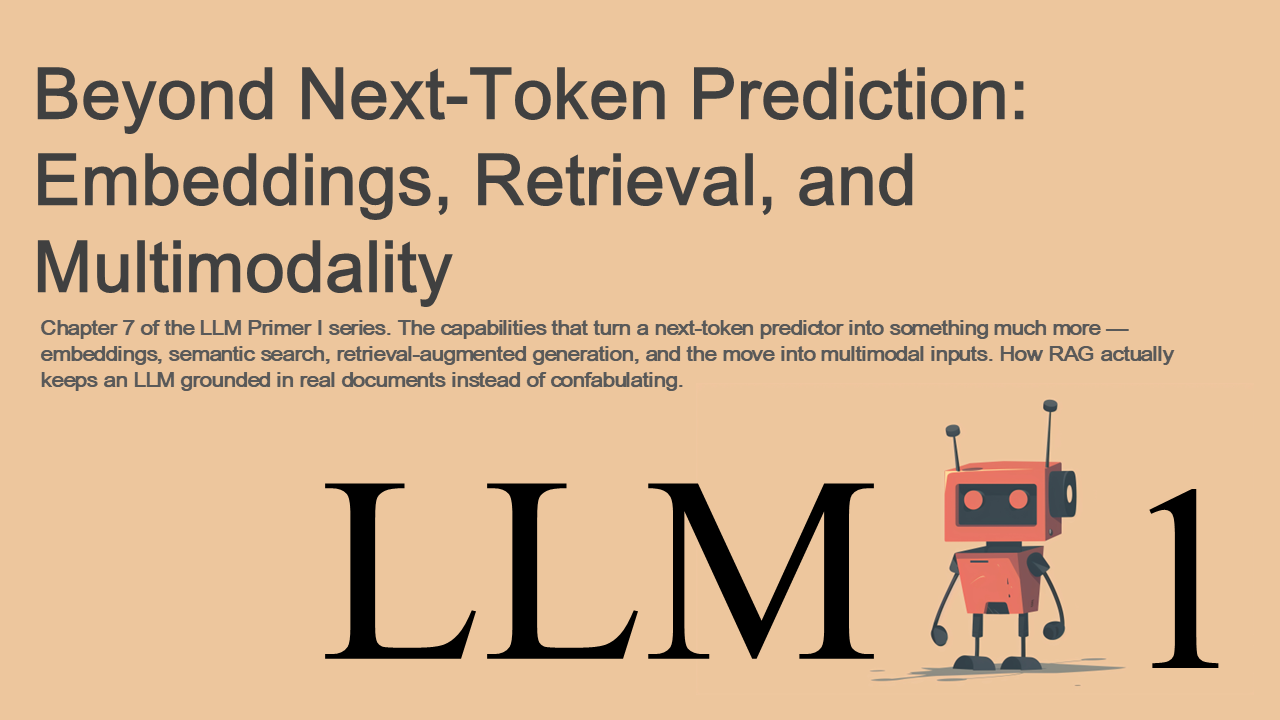
Chapter 7 — Beyond Next-Token Prediction: Embeddings, Retrieval, and Multimodality

Chapter 7 of the LLM Primer I series. The capabilities that turn a next-token predictor into something much more — embeddings, semantic search, retrieval-augmented generation, and the move into multimodal inputs. How RAG actually keeps an LLM grounded in real documents instead of confabulating.

2026-02-24
Chapter 6 — Fine-Tuning & Adaptation: From Raw Model to Helpful Assistant

Chapter 6 of the LLM Primer I series. The full adaptation stack — from cheap prompt-based steering to parameter-efficient fine-tuning to full alignment with RLHF and its modern successors like DPO. Why post-training is now where closed-model APIs actually differentiate.

2026-02-23

A Chapter-by-Chapter Walkthrough of LLM Primer I — Series Introduction & Index

Introduction and index for the twelve-part chapter-by-chapter walkthrough of LLM Primer I: How Generative AI Works. One post per day, Feb 18 through March 1, 2026. Read them in order or pick the chapter that matters most to you. All twelve are listed and linked here.

2026-02-17

The LLM Primer Series — A Field Guide to Generative AI, Built One Volume at a Time

The LLM Primer Series — a completed seven-volume field guide to generative AI by Sho Shimoda. From foundations to security. Includes Physical AI as sister volume. All 7 volumes available on Amazon.

2026-02-15

7.4 Data Ethics and Bias in Large Language Models

A preview from Chapter 7.4: Discover why large language models inherit bias, the real-world risks, strategies for mitigation, and the growing role of AI governance.

2024-10-09

7.3 Integrating Multimodal Models

A preview from Chapter 7.3: Discover how multimodal models fuse text, images, audio, and video to unlock richer AI capabilities beyond text-only LLMs.

2024-10-09
7.2 Resource-Efficient Training

A preview from Chapter 7.2: Learn how techniques like distillation, quantization, distributed training, and data efficiency make LLMs faster, cheaper, and greener.

2024-10-08

7.1 The Evolution of Large-Scale Models

A preview from Chapter 7.1: Explore how LLMs have scaled from billions to trillions of parameters, the gains in performance, and the rising technical and ethical challenges.

2024-10-07

7.0 Future Outlook and Challenges

A preview from Chapter 7: Explore the future of large language models—ethics, efficiency, multimodal AI, and responsible governance beyond scaling.

2024-10-06

A Guide to LLMs (Large Language Models): Understanding the Foundations of Generative AI

Learn about large language models (LLMs), including GPT, BERT, and T5, their functionality, training processes, and practical applications in NLP. This guide provides insights for engineers interested in leveraging LLMs in various fields.

2024-09-01