Introduction to LLM
This page provides an easy-to-understand guide on LLMs (Large Language Models) from basics to applications for AI enthusiasts.

Chapter 13 — Autoscaling and Cold-Start Mitigation
Thirteenth post of the LLM Primer VI walkthrough. Why standard HPA fails for LLM serving, KEDA for TTFT-aware scaling, Knative scale-to-zero, and CRIU / CUDA graph caching for sub-5-second cold starts.
2026-05-05
LLM Primer IV — Series Introduction & Index
Kicking off the chapter-by-chapter walkthrough of Book IV in the LLM Primer series — Designing AI Cognition with MCP. Why agents need a protocol layer to scale past demoware, who this book is for, and the schedule for the fourteen posts that follow, March 30 through April 12.
2026-03-29
Chapter 11 — Continuous Updates and Pipeline Optimization
Eleventh and final post of the LLM Primer III walkthrough. CDC and incremental indexing keep the corpus fresh, semantic caching and model tiering keep latency down, and a four-stage feedback loop closes the gap between what production tells the team and what the team actually changes — plus a bridge to Volume IV on Model Context Protocol.
2026-03-28
Chapter 13 — Limitations, Risks, and Open Challenges
Eleventh post of the LLM Primer II walkthrough. The honest chapter — the compute and energy ceilings that constrain the field, the biases that scale with the data, and the ethical and societal questions that math alone cannot answer.
2026-03-15
Chapter 9 — Training at Scale
Ninth post of the LLM Primer II walkthrough. How data preprocessing quietly shapes everything that follows, the mathematics of mini-batch learning and parallelism, and the surprisingly subtle question of how to keep a training run numerically stable across thousands of GPUs.
2026-03-11
Chapter 8 — How Models Learn
Eighth post of the LLM Primer II walkthrough. Why over-parameterized models generalize at all, the implicit bias of gradient-based optimization, the empirical scaling laws that forecast capability before training, and the open mathematical questions that still surround LLM theory.
2026-03-10
Chapter 2 — LLMs in Context: Concepts and Background
Second post of the LLM Primer II walkthrough. What an LLM actually is, the three things "pretraining, parameters, scale" really stand for, the unusual nature of language as a data source, and why the transformer rewrote the field in a single year.
2026-03-04
Chapter 9 — Performance, Scaling, and Costs: The Real Engineering Trade-offs
Chapter 9 of the LLM Primer I series. The operational realities of running LLMs at scale — model size vs capability, the latency–throughput trade-off, cost economics, quantization, and edge deployment. Why frontier-tier models are often the wrong choice even when you can afford them.
2026-02-26
Chapter 5 — Training Large Models: What Actually Goes Into a Frontier Model
Chapter 5 of the LLM Primer I series. How frontier LLMs are actually trained — the data pipeline, the loss function, the months of GPU time, and why "training" is now an industrial-scale engineering problem more than a research problem. Demystifies what those hundred-million-dollar training runs are paying for.
2026-02-22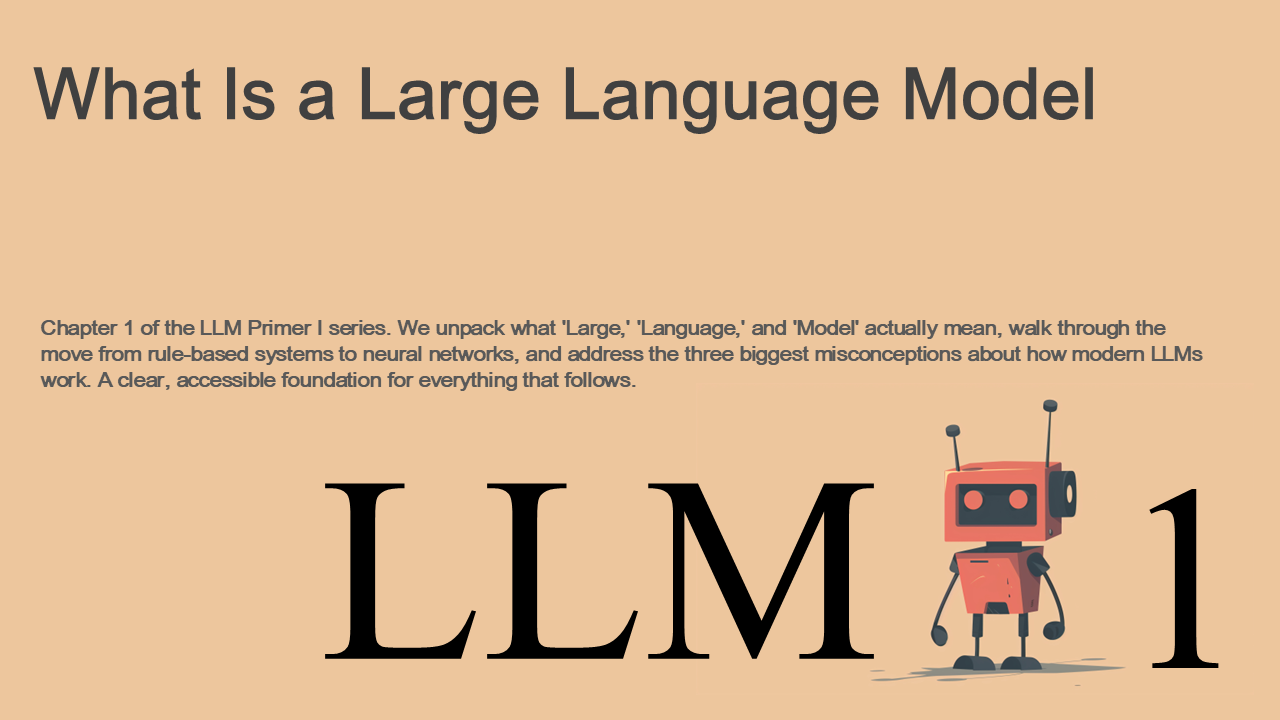
Chapter 1 — What Is a Large Language Model? (Beyond the Headlines)
Chapter 1 of the LLM Primer I series. We unpack what 'Large,' 'Language,' and 'Model' actually mean, walk through the move from rule-based systems to neural networks, and address the three biggest misconceptions about how modern LLMs work. A clear, accessible foundation for everything that follows.
2026-02-182.1 What Is a Large Language Model?
A clear and in-depth explanation of what Large Language Models (LLMs) are. Learn how LLMs map token sequences to probability distributions, why next-token prediction unlocks general intelligence, and what makes a model “large.” This section builds the foundation for understanding pretraining, parameters, and scaling laws.
2025-09-08Chapter 2 — LLMs in Context: Concepts and Background
An accessible introduction to Chapter 2 of Understanding LLMs Through Math. Explore what Large Language Models are, why pretraining and parameters matter, how scaling laws shape model performance, and why Transformers revolutionized NLP. This chapter provides essential context before diving deeper into the mechanics of modern LLMs.
2025-09-071.3 Entropy and Information: Quantifying Uncertainty
A clear, intuitive exploration of entropy, information, and uncertainty in Large Language Models. Learn how information theory shapes next-token prediction, why entropy matters for creativity and coherence, and how cross-entropy connects probability to learning. This section concludes Chapter 1 and prepares readers for the conceptual foundations in Chapter 2.
2025-09-061.2 Basics of Probability for Language Generation
An intuitive, beginner-friendly guide to probability in Large Language Models. Learn how LLMs represent uncertainty, compute conditional probabilities, apply the chain rule, and generate text through sampling. This chapter builds the mathematical foundation for entropy and information theory in Section 1.3.
2025-09-051.1 Getting Comfortable with Mathematical Notation
A clear and accessible guide to understanding the mathematical notation used in Large Language Models. Learn how tokens, sequences, functions, and conditional probability expressions form the foundation of LLM reasoning. This chapter prepares readers for probability, entropy, and information theory in later sections.
2025-09-04Chapter 1 — Mathematical Intuition for Language Models
An accessible introduction to Chapter 1 of Understanding LLMs Through Math. Learn how mathematical notation, probability, entropy, and information theory form the core intuition behind modern Large Language Models. This chapter builds the foundation for understanding how LLMs generate text and quantify uncertainty.
2025-09-03Part I — Mathematical Foundations for Understanding LLMs
A clear and intuitive introduction to the mathematical foundations behind Large Language Models (LLMs). This section explains probability, entropy, embeddings, and the essential concepts that allow modern AI systems to think, reason, and generate language. Learn why mathematics is the timeless core of all LLMs and prepare for Chapter 1: Mathematical Intuition for Language Models.
2025-09-02Understanding LLMs – A Mathematical Approach to the Engine Behind AI
A preview from Chapter 7.4: Discover why large language models inherit bias, the real-world risks, strategies for mitigation, and the growing role of AI governance.
2025-09-01
7.4 Data Ethics and Bias in Large Language Models
A preview from Chapter 7.4: Discover why large language models inherit bias, the real-world risks, strategies for mitigation, and the growing role of AI governance.
2024-10-09
7.1 The Evolution of Large-Scale Models
A preview from Chapter 7.1: Explore how LLMs have scaled from billions to trillions of parameters, the gains in performance, and the rising technical and ethical challenges.
2024-10-07
7.0 Future Outlook and Challenges
A preview from Chapter 7: Explore the future of large language models—ethics, efficiency, multimodal AI, and responsible governance beyond scaling.
2024-10-06
6.2 Simple Python Experiments with LLMs
A preview from Chapter 6.2: Learn how to run large language models with Hugging Face, OpenAI, Google Cloud, and Azure using just Python and a few lines of code.
2024-10-05
6.0 Hands-On with LLMs
A preview from Chapter 6: Learn how to run large language models yourself with open-source libraries, cloud APIs, and Python—making LLMs accessible to everyone.
2024-10-02
5.3 Real-Time Deployment Challenges
A preview from Chapter 5.3: Explore latency, scalability, and optimization techniques for deploying large language models in real-time applications.
2024-10-01
5.2 Compute Resources and Cost
A preview from Chapter 5.2: Learn why LLMs demand massive compute power, what drives cost, and practical strategies to optimize performance and sustainability.
2024-09-30
5.1 Bias & Ethical Considerations
A preview from Chapter 5.1 of our book: uncover how large language models inherit bias and learn strategies to build fair, trustworthy AI.
2024-09-29
5.0 Pitfalls & Best Practices When Using LLMs
Discover the hidden risks of large language models—bias, cost, and latency—and learn best practices for deploying LLMs responsibly.
2024-09-28
4.4 How LLMs Write Code: The Rise of AI-Powered Programming Assistants
Explore how large language models (LLMs) generate and complete code from natural-language prompts, and what it means for the future of software development.
2024-09-27
4.3 LLMs in Translation and Summarization: Enhancing Multilingual Communication
Learn how Large Language Models (LLMs) leverage Transformer architectures for accurate translation and summarization, improving efficiency in business, media, and education.
2024-09-18
4.2 Enhancing Customer Support with LLM-Based Question Answering Systems
Discover how Question Answering Systems powered by Large Language Models (LLMs) are transforming customer support, search engines, and specialized fields with high accuracy and flexibility.
2024-09-17
4.1 Exploring LLM Text Generation: Applications, Use Cases, and Future Trends
Learn how Large Language Models (LLMs) are applied in text generation for content creation, email drafting, creative writing, and chatbots. Discover the mechanics behind text generation and its real-world applications.
2024-09-16
4.0 Applications of LLMs: Text Generation, Question Answering, Translation, and Code Generation
Discover how Large Language Models (LLMs) are used across various NLP tasks, including text generation, question answering, translation, and code generation. Learn about their practical applications and benefits.
2024-09-15
3.3 Fine-Tuning and Transfer Learning for LLMs: Efficient Techniques Explained
Learn how fine-tuning and transfer learning techniques can adapt pre-trained Large Language Models (LLMs) to specific tasks efficiently, saving time and resources while improving accuracy.
2024-09-14
3.2 LLM Training Steps: Forward Propagation, Backward Propagation, and Optimization
Explore the key steps in training Large Language Models (LLMs), including initialization, forward propagation, loss calculation, backward propagation, and hyperparameter tuning. Learn how these processes help optimize model performance.
2024-09-13
3.1 LLM Training: Dataset Selection and Preprocessing Techniques
Learn about dataset selection and preprocessing techniques for training Large Language Models (LLMs). Explore steps like noise removal, tokenization, normalization, and data balancing for optimized model performance.
2024-09-12
3.0 How to Train Large Language Models (LLMs): Data Preparation, Steps, and Fine-Tuning
Learn the key techniques for training Large Language Models (LLMs), including data preprocessing, forward and backward propagation, fine-tuning, and transfer learning. Optimize your model’s performance with efficient training methods.
2024-09-11
2.3 Key LLM Models: BERT, GPT, and T5 Explained
Discover the main differences between BERT, GPT, and T5 in the realm of Large Language Models (LLMs). Learn about their unique features, applications, and how they contribute to various NLP tasks.
2024-09-10
2.2 Understanding the Attention Mechanism in Large Language Models (LLMs)
Learn about the core attention mechanism that powers Large Language Models (LLMs). Discover the concepts of self-attention, scaled dot-product attention, and multi-head attention, and how they contribute to NLP tasks.
2024-09-09
2.1 Transformer Model Explained: Core Architecture of Large Language Models (LLM)
Discover the Transformer model, the backbone of modern Large Language Models (LLM) like GPT and BERT. Learn about its efficient encoder-decoder architecture, self-attention mechanism, and how it revolutionized Natural Language Processing (NLP).
2024-09-07
2.0 The Basics of Large Language Models (LLMs): Transformer Architecture and Key Models
Learn about the foundational elements of Large Language Models (LLMs), including the transformer architecture and attention mechanism. Explore key LLMs like BERT, GPT, and T5, and their applications in NLP.
2024-09-06
1.3 Differences Between Large Language Models (LLMs) and Traditional Machine Learning
Understand the key differences between Large Language Models (LLMs) and traditional machine learning models. Explore how LLMs utilize transformer architecture, offer scalability, and leverage transfer learning for versatile NLP tasks.
2024-09-05
1.2 The Role of Large Language Models (LLMs) in Natural Language Processing (NLP)
Discover the impact of Large Language Models (LLMs) on natural language processing tasks. Learn how LLMs excel in text generation, question answering, translation, summarization, and even code generation.
2024-09-04
1.1 Understanding Large Language Models (LLMs): Definition, Training, and Scalability Explained
Explore the fundamentals of Large Language Models (LLMs), including their structure, training techniques like pre-training and fine-tuning, and the importance of scalability. Discover how LLMs like GPT and BERT work to perform NLP tasks like text generation and translation.
2024-09-03
1.0 What is an LLM? A Guide to Large Language Models in NLP
Discover the basics of Large Language Models (LLMs) in natural language processing (NLP). Learn how LLMs like GPT and BERT are trained, their roles, and how they differ from traditional machine learning models.
2024-09-02
A Guide to LLMs (Large Language Models): Understanding the Foundations of Generative AI
Learn about large language models (LLMs), including GPT, BERT, and T5, their functionality, training processes, and practical applications in NLP. This guide provides insights for engineers interested in leveraging LLMs in various fields.
2024-09-01