Introduction to LLM

This page provides an easy-to-understand guide on LLMs (Large Language Models) from basics to applications for AI enthusiasts.

Total of 36 articles available. | Currently on page 1 of 1.

Chapter 14 — Benchmarking, Testing, and Performance

Fifteenth and final post of the LLM Primer IV walkthrough. The MCP-Universe Benchmark on real servers, the two systemic failure modes it exposed, the ten-times throughput gap between session-per-request and shared session pools, and the bridge to Volume V.

2026-04-12
Chapter 13 — Frameworks and Cloud Integration

Fourteenth post of the LLM Primer IV walkthrough. Strands with Bedrock, the AWS state-layer pattern, the Microsoft Agent Framework, LangChain, Semantic Kernel — and the three production integration shapes teams keep arriving at independently.

2026-04-11
Chapter 12 — Protocol Hardening and Defenses

Thirteenth post of the LLM Primer IV walkthrough. The four defense clusters — cryptographic attestation, OAuth scope discipline with bounded sessions, runtime sandboxing, and human-in-the-loop gates — compose into a posture that does not depend on the model behaving correctly under adversarial conditions.

2026-04-10

Chapter 10 — Long-Horizon Task Memory

Tenth post of the LLM Primer IV walkthrough. Short-term memory through windows and ReAct scratchpads, long-term memory through episodic vectors and semantic stores, and the compaction techniques that keep an agent productive over hours and days.

2026-04-08

Chapter 8 — Architectural Deployment Layouts

Eighth post of the LLM Primer IV walkthrough. The three deployment layouts that have emerged in the MCP ecosystem — reusable agent, strict purity, hybrid — and the four binding constraints that determine which one fits which project.

2026-04-06

Chapter 6 — Fundamental Orchestration Strategies

Sixth post of the LLM Primer IV walkthrough. The two foundational orchestration shapes — sequential pipelines and concurrent scatter-gather — and the prior question every team should ask: is a multi-agent system the right answer at all?

2026-04-04

Chapter 5 — Transport Protocols and Discovery

Fifth post of the LLM Primer IV walkthrough. The three transports MCP supports, the .well-known discovery layer with Server Cards, and the boring operational concerns — CORS, origin validation, caching — that decide whether a server is a cooperative network citizen or a liability.

2026-04-03

Chapter 4 — Client Primitives: Agentic Behaviors and Control

Fourth post of the LLM Primer IV walkthrough. Sampling, Roots, and Elicitation are the three small, controlled holes MCP punches through the host-server wall — each a capability granted back, each a risk accepted on the user's behalf.

2026-04-02

Chapter 2 — Unveiling the Model Context Protocol (MCP)

Second post of the LLM Primer IV walkthrough. What MCP actually standardizes, the three-role split of Host, Client, and Server, why dynamic discovery and bidirectional messaging differ from REST in the cases that matter, and the session lifecycle that opens with capability negotiation.

2026-03-31

Chapter 1 — The AI Integration Crisis and the Rise of Agentic Architecture

First post of the LLM Primer IV walkthrough. Why monolithic agents fray as system prompts grow, the N times M integration problem hiding underneath, and the move from prompt engineering to context engineering that MCP was built to enable.

2026-03-30
LLM Primer IV — Series Introduction & Index

Kicking off the chapter-by-chapter walkthrough of Book IV in the LLM Primer series — Designing AI Cognition with MCP. Why agents need a protocol layer to scale past demoware, who this book is for, and the schedule for the fourteen posts that follow, March 30 through April 12.

2026-03-29

Chapter 8 — Data Anonymization in the RAG Pipeline

Eighth post of the LLM Primer III walkthrough. Pre-generation versus post-generation anonymisation, the three technique families — masking, synthetic replacement, differential privacy — and the utility-privacy tradeoff that determines whether the system remains useful at all.

2026-03-25

Chapter 7 — Implementing Access Control

Seventh post of the LLM Primer III walkthrough. Document-level ACLs as the foundation, RBAC with Microsoft Purview sensitivity labels, ReBAC with Zanzibar and SpiceDB, and the pre-filter versus post-filter discipline that runs underneath all of them.

2026-03-24

Chapter 4 — Selecting the Right Vector Database

Fourth post of the LLM Primer III walkthrough. The architectural split between purpose-built vector databases and Postgres-style extensions, the managed leaders (Pinecone, Vertex), the open-source field (Qdrant, Milvus, Weaviate), the embedded options, and the three operational axes — residency, ops, cost — that decide the real choice.

2026-03-21

Chapter 11 — Evaluation, Calibration, and Inference

Eleventh post of the LLM Primer II walkthrough. Perplexity, calibration, the error bars that every benchmark score should carry, and the mathematics of measuring hallucination — the chapter where we ask how anyone can measure a machine that can say anything.

2026-03-13

Chapter 10 — Post-Training and Alignment Mathematics

Tenth post of the LLM Primer II walkthrough. The mathematics that civilizes a brilliant but feral next-word predictor into a helpful assistant — supervised fine-tuning, reward modeling, RLHF on a KL leash, and the elegant DPO derivation that collapses the whole pipeline into a single supervised loss.

2026-03-12

Chapter 7 — Efficiency and Transformer Variants

Seventh post of the LLM Primer II walkthrough. The computational complexity of attention, the GPU memory and throughput math that constrains real systems, FlashAttention derived from first principles, and the family of clever variants — multi-query, gated, low-rank — that keep big models running.

2026-03-09

Chapter 6 — Transformer Blocks and Representation Power

Sixth post of the LLM Primer II walkthrough. Feed-forward layers, activation functions, why "attention + FFN" is exactly the right pair, and what mathematical guarantees depth and width give you about expressivity.

2026-03-08

Chapter 2 — LLMs in Context: Concepts and Background

Second post of the LLM Primer II walkthrough. What an LLM actually is, the three things "pretraining, parameters, scale" really stand for, the unusual nature of language as a data source, and why the transformer rewrote the field in a single year.

2026-03-04

Chapter 12 — Building Your Own LLM System: From Datasets to Production

Chapter 12 of the LLM Primer I series. The final chapter. What it actually takes to build an LLM-powered system end to end — dataset licensing, training pipelines, evaluation frameworks, the integrated application stack, and the case-study patterns that distinguish successful deployments from failed pilots.

2026-03-01

Chapter 11 — Cutting-Edge Research: MoE, Reasoning Models, and the New Scaling Axis

Chapter 11 of the LLM Primer I series. The research frontiers that are now production reality — mixture-of-experts, retrieval-augmented memory, native multimodal tokenization, continual learning, and the inference-time scaling paradigm that produced today's reasoning models. The 2026 edition's biggest content addition.

2026-02-28

Chapter 9 — Performance, Scaling, and Costs: The Real Engineering Trade-offs

Chapter 9 of the LLM Primer I series. The operational realities of running LLMs at scale — model size vs capability, the latency–throughput trade-off, cost economics, quantization, and edge deployment. Why frontier-tier models are often the wrong choice even when you can afford them.

2026-02-26

Chapter 5 — Training Large Models: What Actually Goes Into a Frontier Model

Chapter 5 of the LLM Primer I series. How frontier LLMs are actually trained — the data pipeline, the loss function, the months of GPU time, and why "training" is now an industrial-scale engineering problem more than a research problem. Demystifies what those hundred-million-dollar training runs are paying for.

2026-02-22

Chapter 4 — The Transformer Architecture: Inside the Engine of Modern AI

Chapter 4 of the LLM Primer I series. A tour of the Transformer block — how self-attention, positional encoding, and stacked layers combine to produce the architecture every modern LLM is built on. Includes a clear explanation of why scaling Transformers works, and what it costs.

2026-02-21

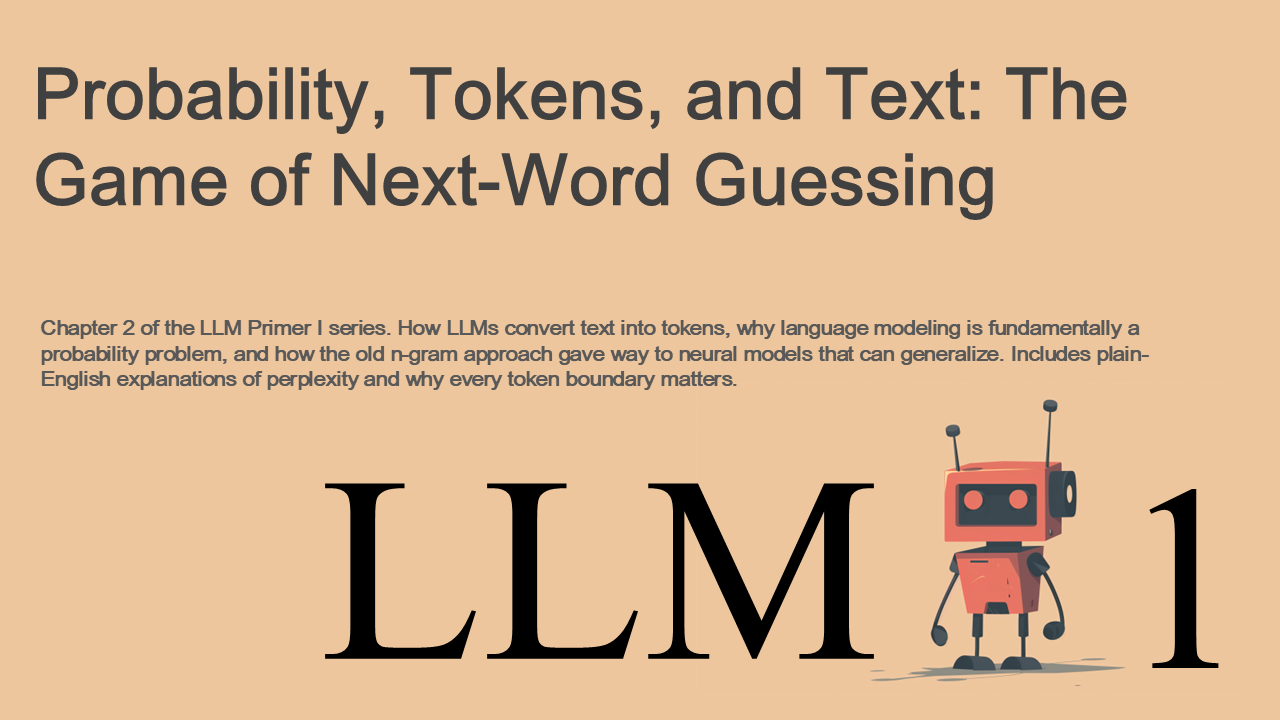
Chapter 2 — Probability, Tokens, and Text: The Game of Next-Word Guessing

Chapter 2 of the LLM Primer I series. How LLMs convert text into tokens, why language modeling is fundamentally a probability problem, and how the old n-gram approach gave way to neural models that can generalize. Includes plain-English explanations of perplexity and why every token boundary matters.

2026-02-19
Chapter 1 — What Is a Large Language Model? (Beyond the Headlines)

Chapter 1 of the LLM Primer I series. We unpack what 'Large,' 'Language,' and 'Model' actually mean, walk through the move from rule-based systems to neural networks, and address the three biggest misconceptions about how modern LLMs work. A clear, accessible foundation for everything that follows.

2026-02-18

1.2 Basics of Probability for Language Generation

An intuitive, beginner-friendly guide to probability in Large Language Models. Learn how LLMs represent uncertainty, compute conditional probabilities, apply the chain rule, and generate text through sampling. This chapter builds the mathematical foundation for entropy and information theory in Section 1.3.

2025-09-05

1.1 Getting Comfortable with Mathematical Notation

A clear and accessible guide to understanding the mathematical notation used in Large Language Models. Learn how tokens, sequences, functions, and conditional probability expressions form the foundation of LLM reasoning. This chapter prepares readers for probability, entropy, and information theory in later sections.

2025-09-04

7.4 Data Ethics and Bias in Large Language Models

A preview from Chapter 7.4: Discover why large language models inherit bias, the real-world risks, strategies for mitigation, and the growing role of AI governance.

2024-10-09

7.3 Integrating Multimodal Models

A preview from Chapter 7.3: Discover how multimodal models fuse text, images, audio, and video to unlock richer AI capabilities beyond text-only LLMs.

2024-10-09

7.2 Resource-Efficient Training

A preview from Chapter 7.2: Learn how techniques like distillation, quantization, distributed training, and data efficiency make LLMs faster, cheaper, and greener.

2024-10-08

6.1 Introducing Open-Source Tools and APIs

A preview from Chapter 6.1: Explore Hugging Face, OpenAI, Google Cloud Vertex AI, and Azure Cognitive Services—leading tools to bring LLMs into your projects.

2024-10-04

4.2 Enhancing Customer Support with LLM-Based Question Answering Systems

Discover how Question Answering Systems powered by Large Language Models (LLMs) are transforming customer support, search engines, and specialized fields with high accuracy and flexibility.

2024-09-17

3.3 Fine-Tuning and Transfer Learning for LLMs: Efficient Techniques Explained

Learn how fine-tuning and transfer learning techniques can adapt pre-trained Large Language Models (LLMs) to specific tasks efficiently, saving time and resources while improving accuracy.

2024-09-14

3.0 How to Train Large Language Models (LLMs): Data Preparation, Steps, and Fine-Tuning

Learn the key techniques for training Large Language Models (LLMs), including data preprocessing, forward and backward propagation, fine-tuning, and transfer learning. Optimize your model’s performance with efficient training methods.

2024-09-11

A Guide to LLMs (Large Language Models): Understanding the Foundations of Generative AI

Learn about large language models (LLMs), including GPT, BERT, and T5, their functionality, training processes, and practical applications in NLP. This guide provides insights for engineers interested in leveraging LLMs in various fields.

2024-09-01