Introduction to LLM

This page provides an easy-to-understand guide on LLMs (Large Language Models) from basics to applications for AI enthusiasts.

Total of 76 articles available. | Currently on page 1 of 2.

Chapter 17 — Future Threats and Emerging Defenses

Seventeenth post of the LLM Primer VII walkthrough — and the series finale. Agent risks and the lethal trifecta, multimodal attack surfaces, deepfakes and C2PA provenance, plus a closing map of the whole LLM Primer arc and the Physical AI sister volume.

2026-05-26

Chapter 12 — Access Control and Identity

Twelfth post of the LLM Primer VII walkthrough. OAuth 2.0 + PKCE, ABAC vs ReBAC (Zanzibar), multi-tenant isolation, and token-bucket rate limits for LLM APIs.

2026-05-21

Chapter 11 — Observability, Logging, and Incident Response

Eleventh post of the LLM Primer VII walkthrough. Structured LLM logging with PII redaction, OpenTelemetry GenAI conventions, and the NIST SP 800-61 IR cycle adapted for probabilistic systems.

2026-05-20

Chapter 10 — Designing Secure LLM Architectures

Tenth post of the LLM Primer VII walkthrough. Isolation boundaries, policy engines (OPA, Cedar), microVM sandboxes, and the "lethal trifecta" of agent + private data + untrusted content.

2026-05-19

Chapter 8 — Adversarial Attacks on Models

Eighth post of the LLM Primer VII walkthrough. Adversarial examples in NLP (HotFlip, TextFooler), model extraction (Tramèr et al., Carlini et al.), and the defensive strategies for API-boundary abuse.

2026-05-17

Chapter 5 — Input Validation and Output Filtering

Fifth post of the LLM Primer VII walkthrough. Input sanitization, structured guardrails (NeMo, Llama Guard 3, Lakera, Bedrock), and red teaming with Garak, PyRIT, and promptfoo.

2026-05-14

Chapter 4 — Prompt Injection and Jailbreaks

Fourth post of the LLM Primer VII walkthrough. Prompt injection as a structural consequence, the jailbreak taxonomy (DAN, grandma, Zou et al. suffixes, Crescendo, Skeleton Key), and the four-layer mitigation matrix.

2026-05-13

Chapter 3 — Data Security and Privacy

Third post of the LLM Primer VII walkthrough. Training-data risks, memorization and extraction (Carlini et al., Nasr et al.), and the encryption, isolation, and retention disciplines that keep sensitive prompts contained.

2026-05-12

Chapter 2 — Threat Modeling for LLM Systems

Second post of the LLM Primer VII walkthrough. Adapting STRIDE, PASTA, and attack trees to LLM systems — model, prompt, data, and infrastructure as assets, and MITRE ATLAS as the LLM-specific adversary catalog.

2026-05-11

Chapter 1 — Why AI Security Is Different

First post of the LLM Primer VII walkthrough. Why LLM security is structurally different from traditional security — the collapsed code/data boundary, the probabilistic core, and the OWASP LLM Top 10 as a working checklist.

2026-05-10

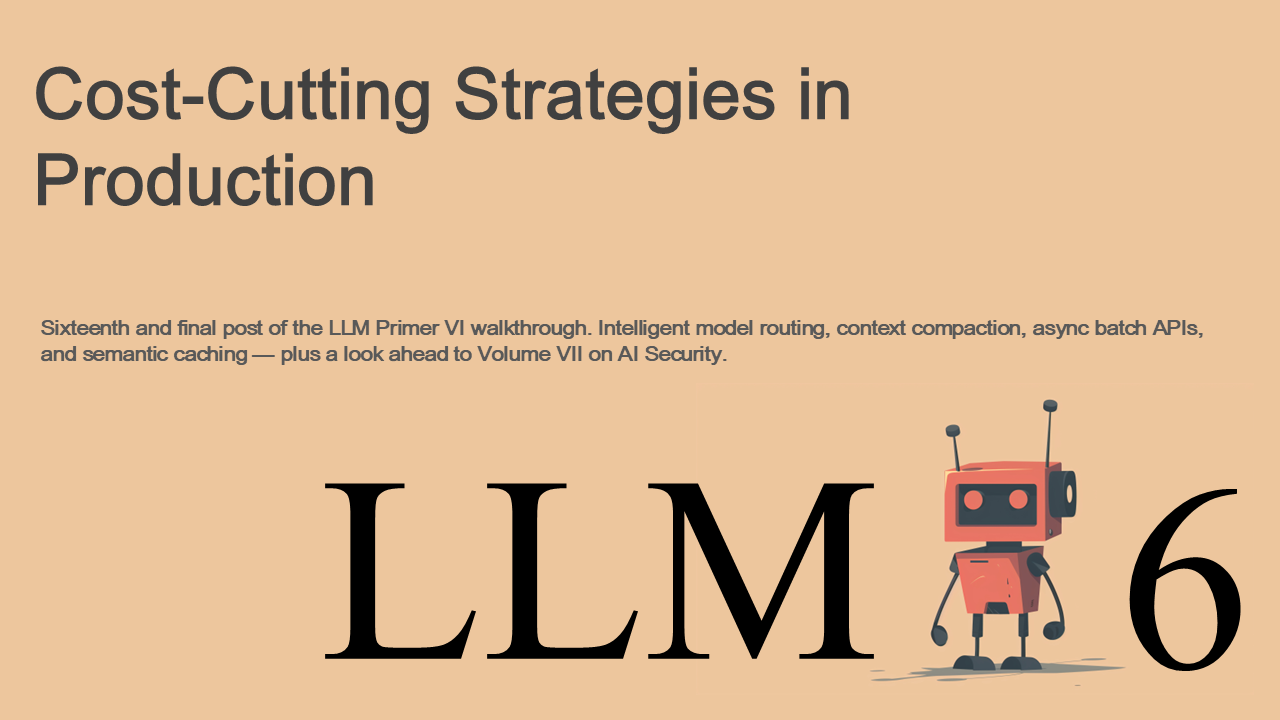
Chapter 16 — Cost-Cutting Strategies in Production

Sixteenth and final post of the LLM Primer VI walkthrough. Intelligent model routing, context compaction, async batch APIs, and semantic caching — plus a look ahead to Volume VII on AI Security.

2026-05-08
Chapter 15 — Serverless APIs vs Dedicated Infrastructure

Fifteenth post of the LLM Primer VI walkthrough. The breakeven math between serverless APIs and dedicated infrastructure, the hidden platform-engineering overhead each side takes on, and microVM sandboxes for agent code execution.

2026-05-07

Chapter 14 — Token Economics and API Pricing

Fourteenth post of the LLM Primer VI walkthrough. The input-vs-output token asymmetry, the hidden cost of conversation history, and the invisible reasoning tokens that quietly rewrite the daily bill.

2026-05-06
Chapter 13 — Autoscaling and Cold-Start Mitigation

Thirteenth post of the LLM Primer VI walkthrough. Why standard HPA fails for LLM serving, KEDA for TTFT-aware scaling, Knative scale-to-zero, and CRIU / CUDA graph caching for sub-5-second cold starts.

2026-05-05

Chapter 12 — Disaggregated Serving and Kubernetes

Twelfth post of the LLM Primer VI walkthrough. Why aggregating prefill and decode wastes compute, and how LeaderWorkerSet, NVIDIA Grove, and KAI Scheduler split them apart on Kubernetes.

2026-05-04

Chapter 10 — The LLM Engine Layer

Tenth post of the LLM Primer VI walkthrough. vLLM as the safe default, TensorRT-LLM for peak NVIDIA-only throughput, SGLang for structured and agentic outputs, and TGI/Ollama for the rest.

2026-05-02

Chapter 9 — Speculative Decoding

Ninth post of the LLM Primer VI walkthrough. The draft-verify paradigm — EAGLE, Medusa, MTP, Lookahead, N-gram — and the verification bottleneck that decides real speedup.

2026-05-01

Chapter 8 — Next-Generation KV Cache Management

Eighth post of the LLM Primer VI walkthrough. PagedAttention, KV eviction algorithms (H2O, InfiniGen), and prefix caching for multi-turn conversations and multi-agent RAG.

2026-04-30

Chapter 7 — Advanced Batching Strategies

Seventh post of the LLM Primer VI walkthrough. Static vs dynamic vs continuous (in-flight) batching, iteration-level scheduling, and how a batch's slots actually progress on the GPU.

2026-04-29

Chapter 6 — Pruning and Knowledge Distillation

Sixth post of the LLM Primer VI walkthrough. Structured vs unstructured pruning, 2:4 sparsity on Hopper, and the distillation lineage from soft probabilities to Patient Knowledge Distillation and MiniLLM.

2026-04-28

Chapter 4 — Specialized AI Silicon and ASICs

Fourth post of the LLM Primer VI walkthrough. Groq LPUs, AWS Inferentia2, Google TPUs, and Intel Gaudi — where specialized silicon fits alongside general-purpose GPUs.

2026-04-26

Chapter 3 — Data Center GPUs for Generative AI

Third post of the LLM Primer VI walkthrough. The NVIDIA lineup (H100, H200, B200, L40S) vs AMD MI300X — and why HBM bandwidth matters more than FLOPs for decoding.

2026-04-25

Chapter 2 — The KV Cache Challenge

Second post of the LLM Primer VI walkthrough. The KV cache formula, the attention-variant trade-offs (MHA vs GQA vs MQA), and the memory-fragmentation problem PagedAttention solves.

2026-04-24

Chapter 1 — The Mechanics of Token Generation

First post of the LLM Primer VI walkthrough. The autoregressive bottleneck, the prefill/decode split, and why a high-end GPU is 99.7% idle while serving a single user.

2026-04-23

LLM Primer VI — Series Introduction & Index

Kicking off the chapter-by-chapter walkthrough of Book VI in the LLM Primer series — Scaling AI Systems. Why inference is the discipline that decides whether an LLM app survives real users, and the schedule for the sixteen posts that follow, April 23 through May 8.

2026-04-22

Chapter 8 — Optimizing Performance, Serving, and Cost

Eighth and final post of the LLM Primer V walkthrough. Semantic caching, dynamic model routing, and what actually happens inside the inference server — plus a look ahead to Volume VI on scaling.

2026-04-21
Chapter 7 — LLM Security and Guardrails

Seventh post of the LLM Primer V walkthrough. The OWASP LLM Top 10 as a working checklist, direct-versus-indirect prompt injection, and the four-layer mitigation matrix.

2026-04-20

Chapter 6 — AI Observability and Tracing

Sixth post of the LLM Primer V walkthrough. OpenTelemetry GenAI conventions, span design for LLM apps, cost tracking, and the loop back into the evaluation harness.

2026-04-19
Chapter 5 — Evaluating LLM Applications

Fifth post of the LLM Primer V walkthrough. The offline-online eval distinction, LLM-as-judge patterns, the RAG Triad, and trajectory tests for agents.

2026-04-18

Chapter 4 — AI Agents and Tool Calling

Fourth post of the LLM Primer V walkthrough. ReAct loops, tool schemas as contracts, and the three memory layers agents actually need in production.

2026-04-17

Chapter 2 — Foundation Models & Prompt Engineering

Second post of the LLM Primer V walkthrough. Model tiering, sampling parameters, defensive prompt patterns, and structured outputs as engineering surfaces — the layer just inside the deterministic wrapper.

2026-04-15

Chapter 1 — The Discipline of AI Engineering

First post of the LLM Primer V walkthrough. Why the demo works and production doesn't — the deterministic wrapper around the probabilistic core, and the five pillars (reliability, quality, performance, cost, evolution) that keep the wrapper honest.

2026-04-14
LLM Primer V — Series Introduction & Index

Kicking off the chapter-by-chapter walkthrough of Book V in the LLM Primer series — Building Real-World LLM Applications. Why AI engineering is a discipline of its own, who this book is for, and the schedule for the eight posts that follow, April 14 through April 21.

2026-04-13

Chapter 14 — Benchmarking, Testing, and Performance

Fifteenth and final post of the LLM Primer IV walkthrough. The MCP-Universe Benchmark on real servers, the two systemic failure modes it exposed, the ten-times throughput gap between session-per-request and shared session pools, and the bridge to Volume V.

2026-04-12

Chapter 13 — Frameworks and Cloud Integration

Fourteenth post of the LLM Primer IV walkthrough. Strands with Bedrock, the AWS state-layer pattern, the Microsoft Agent Framework, LangChain, Semantic Kernel — and the three production integration shapes teams keep arriving at independently.

2026-04-11

Chapter 12 — Protocol Hardening and Defenses

Thirteenth post of the LLM Primer IV walkthrough. The four defense clusters — cryptographic attestation, OAuth scope discipline with bounded sessions, runtime sandboxing, and human-in-the-loop gates — compose into a posture that does not depend on the model behaving correctly under adversarial conditions.

2026-04-10

Chapter 10 — Long-Horizon Task Memory

Tenth post of the LLM Primer IV walkthrough. Short-term memory through windows and ReAct scratchpads, long-term memory through episodic vectors and semantic stores, and the compaction techniques that keep an agent productive over hours and days.

2026-04-08

Chapter 9 — Managing the Attention Budget

Ninth post of the LLM Primer IV walkthrough. Context rot, the lost-in-the-middle cliff, tool-loadout rot, and the three architectural answers — MCP, RAG, fine-tuning — to the question of where a model's missing knowledge actually belongs.

2026-04-07

Chapter 8 — Architectural Deployment Layouts

Eighth post of the LLM Primer IV walkthrough. The three deployment layouts that have emerged in the MCP ecosystem — reusable agent, strict purity, hybrid — and the four binding constraints that determine which one fits which project.

2026-04-06

Chapter 7 — Advanced Collaborative and Dynamic Patterns

Seventh post of the LLM Primer IV walkthrough. Roundtable consensus, handoff routing, and magentic orchestration — the patterns that emerge when the topology has to be built per request, with the failure modes (non-termination, mis-routing, runaway planning) the simpler patterns avoid.

2026-04-05

Chapter 6 — Fundamental Orchestration Strategies

Sixth post of the LLM Primer IV walkthrough. The two foundational orchestration shapes — sequential pipelines and concurrent scatter-gather — and the prior question every team should ask: is a multi-agent system the right answer at all?

2026-04-04

Chapter 4 — Client Primitives: Agentic Behaviors and Control

Fourth post of the LLM Primer IV walkthrough. Sampling, Roots, and Elicitation are the three small, controlled holes MCP punches through the host-server wall — each a capability granted back, each a risk accepted on the user's behalf.

2026-04-02

Chapter 2 — Unveiling the Model Context Protocol (MCP)

Second post of the LLM Primer IV walkthrough. What MCP actually standardizes, the three-role split of Host, Client, and Server, why dynamic discovery and bidirectional messaging differ from REST in the cases that matter, and the session lifecycle that opens with capability negotiation.

2026-03-31

Chapter 1 — The AI Integration Crisis and the Rise of Agentic Architecture

First post of the LLM Primer IV walkthrough. Why monolithic agents fray as system prompts grow, the N times M integration problem hiding underneath, and the move from prompt engineering to context engineering that MCP was built to enable.

2026-03-30

LLM Primer IV — Series Introduction & Index

Kicking off the chapter-by-chapter walkthrough of Book IV in the LLM Primer series — Designing AI Cognition with MCP. Why agents need a protocol layer to scale past demoware, who this book is for, and the schedule for the fourteen posts that follow, March 30 through April 12.

2026-03-29

Chapter 11 — Continuous Updates and Pipeline Optimization

Eleventh and final post of the LLM Primer III walkthrough. CDC and incremental indexing keep the corpus fresh, semantic caching and model tiering keep latency down, and a four-stage feedback loop closes the gap between what production tells the team and what the team actually changes — plus a bridge to Volume IV on Model Context Protocol.

2026-03-28

Chapter 10 — Leading Evaluation Frameworks

Tenth post of the LLM Primer III walkthrough. A field guide to the frameworks that turn the Evaluation Triad into something a team can actually run — RAGAS, TruLens, DeepEval on one side, Braintrust, LangSmith, Phoenix, Galileo, Opik on the other, and the Evaluation Gap none of them has yet closed.

2026-03-27

Chapter 8 — Data Anonymization in the RAG Pipeline

Eighth post of the LLM Primer III walkthrough. Pre-generation versus post-generation anonymisation, the three technique families — masking, synthetic replacement, differential privacy — and the utility-privacy tradeoff that determines whether the system remains useful at all.

2026-03-25

Chapter 7 — Implementing Access Control

Seventh post of the LLM Primer III walkthrough. Document-level ACLs as the foundation, RBAC with Microsoft Purview sensitivity labels, ReBAC with Zanzibar and SpiceDB, and the pre-filter versus post-filter discipline that runs underneath all of them.

2026-03-24

Chapter 6 — RAG Threat Models and Vulnerabilities

Sixth post of the LLM Primer III walkthrough. The expanded attack surface of retrieval — corpus poisoning, adversarial chunks, indirect prompt injection, embedding inversion, and the confused-deputy problem in agentic RAG. Concrete attacks, each demonstrated, each reproducible.

2026-03-23