Introduction to LLM

This page provides an easy-to-understand guide on LLMs (Large Language Models) from basics to applications for AI enthusiasts.

Total of 58 articles available. | Currently on page 1 of 2.

Chapter 17 — Future Threats and Emerging Defenses

Seventeenth post of the LLM Primer VII walkthrough — and the series finale. Agent risks and the lethal trifecta, multimodal attack surfaces, deepfakes and C2PA provenance, plus a closing map of the whole LLM Primer arc and the Physical AI sister volume.

2026-05-26

Chapter 14 — Bias, Fairness, and Responsible AI

Fourteenth post of the LLM Primer VII walkthrough. Sources of bias in LLMs, measurement (BBQ, BOLD, StereoSet, HELM), and the safety-utility trade-off honestly named.

2026-05-23

Chapter 8 — Adversarial Attacks on Models

Eighth post of the LLM Primer VII walkthrough. Adversarial examples in NLP (HotFlip, TextFooler), model extraction (Tramèr et al., Carlini et al.), and the defensive strategies for API-boundary abuse.

2026-05-17

Chapter 13 — Autoscaling and Cold-Start Mitigation

Thirteenth post of the LLM Primer VI walkthrough. Why standard HPA fails for LLM serving, KEDA for TTFT-aware scaling, Knative scale-to-zero, and CRIU / CUDA graph caching for sub-5-second cold starts.

2026-05-05

Chapter 12 — Disaggregated Serving and Kubernetes

Twelfth post of the LLM Primer VI walkthrough. Why aggregating prefill and decode wastes compute, and how LeaderWorkerSet, NVIDIA Grove, and KAI Scheduler split them apart on Kubernetes.

2026-05-04

Chapter 10 — The LLM Engine Layer

Tenth post of the LLM Primer VI walkthrough. vLLM as the safe default, TensorRT-LLM for peak NVIDIA-only throughput, SGLang for structured and agentic outputs, and TGI/Ollama for the rest.

2026-05-02

Chapter 9 — Speculative Decoding

Ninth post of the LLM Primer VI walkthrough. The draft-verify paradigm — EAGLE, Medusa, MTP, Lookahead, N-gram — and the verification bottleneck that decides real speedup.

2026-05-01

Chapter 8 — Next-Generation KV Cache Management

Eighth post of the LLM Primer VI walkthrough. PagedAttention, KV eviction algorithms (H2O, InfiniGen), and prefix caching for multi-turn conversations and multi-agent RAG.

2026-04-30

Chapter 7 — Advanced Batching Strategies

Seventh post of the LLM Primer VI walkthrough. Static vs dynamic vs continuous (in-flight) batching, iteration-level scheduling, and how a batch's slots actually progress on the GPU.

2026-04-29

Chapter 6 — Pruning and Knowledge Distillation

Sixth post of the LLM Primer VI walkthrough. Structured vs unstructured pruning, 2:4 sparsity on Hopper, and the distillation lineage from soft probabilities to Patient Knowledge Distillation and MiniLLM.

2026-04-28

Chapter 5 — Demystifying Quantization

Fifth post of the LLM Primer VI walkthrough. From BF16 to INT4 to Blackwell FP4 — quantization algorithms (AWQ, GPTQ, GGUF, SmoothQuant), NVIDIA ModelOpt, and when quantization is safe versus lossy.

2026-04-27

Chapter 4 — Specialized AI Silicon and ASICs

Fourth post of the LLM Primer VI walkthrough. Groq LPUs, AWS Inferentia2, Google TPUs, and Intel Gaudi — where specialized silicon fits alongside general-purpose GPUs.

2026-04-26

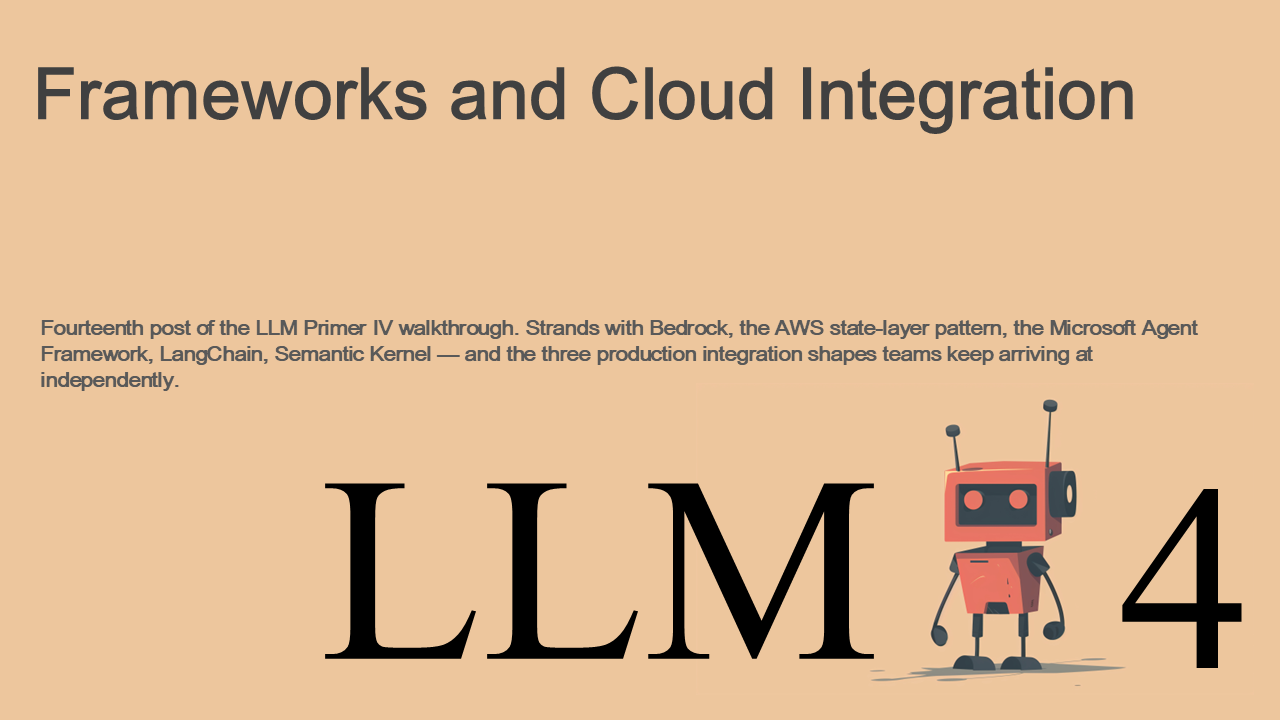
Chapter 2 — The KV Cache Challenge

Second post of the LLM Primer VI walkthrough. The KV cache formula, the attention-variant trade-offs (MHA vs GQA vs MQA), and the memory-fragmentation problem PagedAttention solves.

2026-04-24
Chapter 1 — The Mechanics of Token Generation

First post of the LLM Primer VI walkthrough. The autoregressive bottleneck, the prefill/decode split, and why a high-end GPU is 99.7% idle while serving a single user.

2026-04-23

Chapter 2 — Foundation Models & Prompt Engineering

Second post of the LLM Primer V walkthrough. Model tiering, sampling parameters, defensive prompt patterns, and structured outputs as engineering surfaces — the layer just inside the deterministic wrapper.

2026-04-15

Chapter 14 — Benchmarking, Testing, and Performance

Fifteenth and final post of the LLM Primer IV walkthrough. The MCP-Universe Benchmark on real servers, the two systemic failure modes it exposed, the ten-times throughput gap between session-per-request and shared session pools, and the bridge to Volume V.

2026-04-12

Chapter 13 — Frameworks and Cloud Integration

Fourteenth post of the LLM Primer IV walkthrough. Strands with Bedrock, the AWS state-layer pattern, the Microsoft Agent Framework, LangChain, Semantic Kernel — and the three production integration shapes teams keep arriving at independently.

2026-04-11
Chapter 12 — Protocol Hardening and Defenses

Thirteenth post of the LLM Primer IV walkthrough. The four defense clusters — cryptographic attestation, OAuth scope discipline with bounded sessions, runtime sandboxing, and human-in-the-loop gates — compose into a posture that does not depend on the model behaving correctly under adversarial conditions.

2026-04-10

Chapter 9 — Managing the Attention Budget

Ninth post of the LLM Primer IV walkthrough. Context rot, the lost-in-the-middle cliff, tool-loadout rot, and the three architectural answers — MCP, RAG, fine-tuning — to the question of where a model's missing knowledge actually belongs.

2026-04-07
Chapter 8 — Architectural Deployment Layouts

Eighth post of the LLM Primer IV walkthrough. The three deployment layouts that have emerged in the MCP ecosystem — reusable agent, strict purity, hybrid — and the four binding constraints that determine which one fits which project.

2026-04-06

Chapter 6 — Fundamental Orchestration Strategies

Sixth post of the LLM Primer IV walkthrough. The two foundational orchestration shapes — sequential pipelines and concurrent scatter-gather — and the prior question every team should ask: is a multi-agent system the right answer at all?

2026-04-04

Chapter 4 — Client Primitives: Agentic Behaviors and Control

Fourth post of the LLM Primer IV walkthrough. Sampling, Roots, and Elicitation are the three small, controlled holes MCP punches through the host-server wall — each a capability granted back, each a risk accepted on the user's behalf.

2026-04-02

Chapter 1 — The AI Integration Crisis and the Rise of Agentic Architecture

First post of the LLM Primer IV walkthrough. Why monolithic agents fray as system prompts grow, the N times M integration problem hiding underneath, and the move from prompt engineering to context engineering that MCP was built to enable.

2026-03-30

LLM Primer IV — Series Introduction & Index

Kicking off the chapter-by-chapter walkthrough of Book IV in the LLM Primer series — Designing AI Cognition with MCP. Why agents need a protocol layer to scale past demoware, who this book is for, and the schedule for the fourteen posts that follow, March 30 through April 12.

2026-03-29

Chapter 6 — RAG Threat Models and Vulnerabilities

Sixth post of the LLM Primer III walkthrough. The expanded attack surface of retrieval — corpus poisoning, adversarial chunks, indirect prompt injection, embedding inversion, and the confused-deputy problem in agentic RAG. Concrete attacks, each demonstrated, each reproducible.

2026-03-23

Chapter 5 — Architecting the Retrieval Pipeline

Fifth post of the LLM Primer III walkthrough. Why a single vector search is not a pipeline — hybrid retrieval, reciprocal rank fusion, cross-encoder reranking, and query-side rewriting and HyDE — assembled into the production architecture that mature RAG systems converge on.

2026-03-22

Chapter 2 — Intelligent Document Parsing

Second post of the LLM Primer III walkthrough. Why a PDF is not a text file, what layout-aware parsers actually preserve, the current tool landscape (LlamaParse, Docling, Unstructured, Marker-PDF, Firecrawl, DeepSeek-OCR), and the multimodal track that retrieves over page images directly.

2026-03-19

Chapter 14 — Practical Knowledge for Engineers

Twelfth post — the closing chapter of the LLM Primer II walkthrough. How to keep deepening your understanding after the book ends, the tools and libraries that turn the math into shipping work, and the bridge to the other books in the LLM Primer series.

2026-03-16

Chapter 10 — Post-Training and Alignment Mathematics

Tenth post of the LLM Primer II walkthrough. The mathematics that civilizes a brilliant but feral next-word predictor into a helpful assistant — supervised fine-tuning, reward modeling, RLHF on a KL leash, and the elegant DPO derivation that collapses the whole pipeline into a single supervised loss.

2026-03-12

Chapter 8 — How Models Learn

Eighth post of the LLM Primer II walkthrough. Why over-parameterized models generalize at all, the implicit bias of gradient-based optimization, the empirical scaling laws that forecast capability before training, and the open mathematical questions that still surround LLM theory.

2026-03-10

Chapter 7 — Efficiency and Transformer Variants

Seventh post of the LLM Primer II walkthrough. The computational complexity of attention, the GPU memory and throughput math that constrains real systems, FlashAttention derived from first principles, and the family of clever variants — multi-query, gated, low-rank — that keep big models running.

2026-03-09
Chapter 6 — Transformer Blocks and Representation Power

Sixth post of the LLM Primer II walkthrough. Feed-forward layers, activation functions, why "attention + FFN" is exactly the right pair, and what mathematical guarantees depth and width give you about expressivity.

2026-03-08
Chapter 5 — Position, Order, and Sequence Structure

Fifth post of the LLM Primer II walkthrough. How transformers acquire a sense of order — from the original sinusoidal encoding to relative position to RoPE — and a striking final view that ties the whole apparatus to Fourier analysis.

2026-03-07

Chapter 4 — Attention: The Core Mechanism

Fourth post of the LLM Primer II walkthrough. Self-attention derived from intuition, the geometry of queries/keys/values, multi-head structure and normalization, softmax in detail with its temperature knob, and a striking final move: attention seen as a kernel method.

2026-03-06
Chapter 3 — Mathematical Tools for Language Models

Third post of the LLM Primer II walkthrough. The probability and statistics you actually need for language modeling, the slice of linear algebra that matters, and embeddings as the first place those two tools meet inside an LLM.

2026-03-05

Chapter 2 — LLMs in Context: Concepts and Background

Second post of the LLM Primer II walkthrough. What an LLM actually is, the three things "pretraining, parameters, scale" really stand for, the unusual nature of language as a data source, and why the transformer rewrote the field in a single year.

2026-03-04

Chapter 1 — Mathematical Intuition for Language Models

First post of the LLM Primer II walkthrough. Mathematical notation without intimidation, probability for language generation explained from scratch, and entropy as a way to measure uncertainty — the trio that makes the rest of the book readable.

2026-03-03

LLM Primer II — Language Models Through Mathematics: Series Introduction & Index

Kicking off the chapter-by-chapter walkthrough of Book II in the LLM Primer series — Language Models Through Mathematics. How the book is organized, what each chapter delivers, and the schedule for the fourteen posts that follow, March 3 through March 16.

2026-03-02

Chapter 9 — Performance, Scaling, and Costs: The Real Engineering Trade-offs

Chapter 9 of the LLM Primer I series. The operational realities of running LLMs at scale — model size vs capability, the latency–throughput trade-off, cost economics, quantization, and edge deployment. Why frontier-tier models are often the wrong choice even when you can afford them.

2026-02-26

Chapter 4 — The Transformer Architecture: Inside the Engine of Modern AI

Chapter 4 of the LLM Primer I series. A tour of the Transformer block — how self-attention, positional encoding, and stacked layers combine to produce the architecture every modern LLM is built on. Includes a clear explanation of why scaling Transformers works, and what it costs.

2026-02-21
Chapter 3 — Neural Networks for Language: From RNNs to Self-Attention

Chapter 3 of the LLM Primer I series. Why feedforward networks couldn't handle language, how RNNs hit a wall, and what attention changed. A clean conceptual progression through the three neural-network shapes that defined modern NLP — without the math anxiety.

2026-02-20
Chapter 1 — What Is a Large Language Model? (Beyond the Headlines)

Chapter 1 of the LLM Primer I series. We unpack what 'Large,' 'Language,' and 'Model' actually mean, walk through the move from rule-based systems to neural networks, and address the three biggest misconceptions about how modern LLMs work. A clear, accessible foundation for everything that follows.

2026-02-18

A Chapter-by-Chapter Walkthrough of LLM Primer I — Series Introduction & Index

Introduction and index for the twelve-part chapter-by-chapter walkthrough of LLM Primer I: How Generative AI Works. One post per day, Feb 18 through March 1, 2026. Read them in order or pick the chapter that matters most to you. All twelve are listed and linked here.

2026-02-17

The LLM Primer Series — A Field Guide to Generative AI, Built One Volume at a Time

The LLM Primer Series — a completed seven-volume field guide to generative AI by Sho Shimoda. From foundations to security. Includes Physical AI as sister volume. All 7 volumes available on Amazon.

2026-02-15

2.1 What Is a Large Language Model?

A clear and in-depth explanation of what Large Language Models (LLMs) are. Learn how LLMs map token sequences to probability distributions, why next-token prediction unlocks general intelligence, and what makes a model “large.” This section builds the foundation for understanding pretraining, parameters, and scaling laws.

2025-09-08

Chapter 2 — LLMs in Context: Concepts and Background

An accessible introduction to Chapter 2 of Understanding LLMs Through Math. Explore what Large Language Models are, why pretraining and parameters matter, how scaling laws shape model performance, and why Transformers revolutionized NLP. This chapter provides essential context before diving deeper into the mechanics of modern LLMs.

2025-09-07

1.2 Basics of Probability for Language Generation

An intuitive, beginner-friendly guide to probability in Large Language Models. Learn how LLMs represent uncertainty, compute conditional probabilities, apply the chain rule, and generate text through sampling. This chapter builds the mathematical foundation for entropy and information theory in Section 1.3.

2025-09-05

1.1 Getting Comfortable with Mathematical Notation

A clear and accessible guide to understanding the mathematical notation used in Large Language Models. Learn how tokens, sequences, functions, and conditional probability expressions form the foundation of LLM reasoning. This chapter prepares readers for probability, entropy, and information theory in later sections.

2025-09-04

Chapter 1 — Mathematical Intuition for Language Models

An accessible introduction to Chapter 1 of Understanding LLMs Through Math. Learn how mathematical notation, probability, entropy, and information theory form the core intuition behind modern Large Language Models. This chapter builds the foundation for understanding how LLMs generate text and quantify uncertainty.

2025-09-03

Part I — Mathematical Foundations for Understanding LLMs

A clear and intuitive introduction to the mathematical foundations behind Large Language Models (LLMs). This section explains probability, entropy, embeddings, and the essential concepts that allow modern AI systems to think, reason, and generate language. Learn why mathematics is the timeless core of all LLMs and prepare for Chapter 1: Mathematical Intuition for Language Models.

2025-09-02